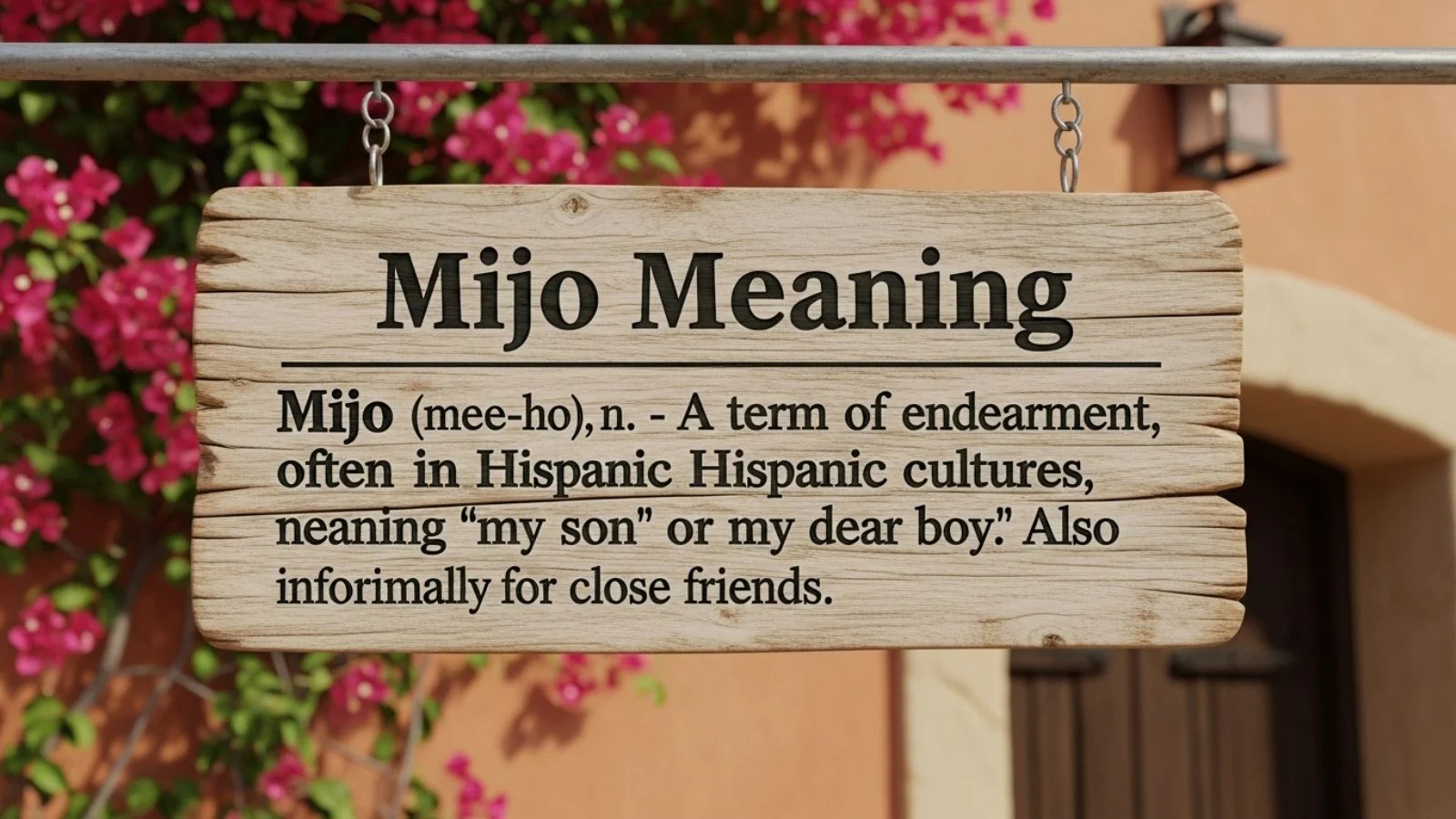
Language is full of warm and loving words. One such word is mijo. Many people hear it in movies, songs, or daily talk and wonder what it really means.
In this complete guide, you will learn the mijo meaning, where it comes from, how people use it, and what it shows about personality and culture. Everything is explained in very simple English so anyone can understand.
Let’s begin.
What Does Mijo Mean?
The word mijo is a Spanish term of affection.
It means “my son.”
But in daily speech, it does not always mean your real son. It is often used as a loving nickname for:
- A boy
- A young man
- A child
- Someone younger than you
- Someone you care about
Simple Definition
Mijo means “my son,” but people use it as a warm and caring way to talk to a boy or young man.
It is like saying:
- “Sweetie”
- “Dear”
- “My boy”
- “Son” (in a loving way)
It shows love, care, and closeness.
Where Does Mijo Come From? (Origin and History)
The word mijo comes from Spanish.
It is a short form of:
Mi hijo
In Spanish:
- Mi = my
- Hijo = son
When spoken quickly, “mi hijo” sounds like mijo. Over time, people began writing and saying it as one word in informal speech.
Historical Background
Spanish has always used affectionate words inside families. In many Spanish-speaking cultures:
- Parents use loving nicknames.
- Grandparents use soft terms for children.
- Older adults call young people by caring names.
Mijo became popular in countries like:
- Mexico
- Spain
- Colombia
- Argentina
- Many Latin American countries
- Hispanic communities in the United States
Today, it is common in both Spanish-speaking homes and bilingual families.
Is Mijo Only for Sons?
No.
This is very important.
Even though it means “my son,” people use mijo for:
- A nephew
- A grandson
- A student
- A neighbor’s child
- A young male friend
- Even a boyfriend in some cases
It does not always mean the person is your real son.
It simply shows affection and warmth.
The Female Version of Mijo
The female form of mijo is:
Mija
It comes from:
Mi hija
(My daughter)
So:
- Mijo = my son
- Mija = my daughter
Both are used with love.
How Do People Use Mijo in Real Life?
Let’s look at simple examples.
Each example has a short explanation so beginners understand clearly.
Example 1: A Mother Talking to Her Son
Mother: “Mijo, did you eat lunch?”
Son: “Yes, Mom.”
Explanation: The mother uses mijo to show love and care.
Example 2: A Grandmother Giving Advice
Grandmother: “Mijo, study hard and follow your dreams.”
Explanation: The grandmother uses mijo as a warm and encouraging word.
Example 3: A Teacher Talking to a Student
Teacher: “Mijo, please finish your homework.”
Explanation: The teacher uses it kindly, not strictly. It shows softness.
Example 4: An Older Neighbor Speaking
Neighbor: “Mijo, help me carry these bags.”
Explanation: The neighbor uses it to show familiarity and friendliness.
Example 5: In a Romantic Way
Girlfriend: “Mijo, you always make me smile.”
Explanation: Here, it shows affection between partners.
What Personality Traits Does “Mijo” Show?
When someone says mijo, it often shows certain traits.
1. Warmth
The speaker is kind and caring.
2. Family-Oriented Nature
The word reflects strong family values.
3. Emotional Connection
It shows closeness, not distance.
4. Respect with Love
Even when giving advice, the tone feels gentle.
5. Cultural Pride
Many Hispanic families use it proudly as part of their identity.
When Is It Appropriate to Use Mijo?
Here is a simple table to understand better:
| Situation | Is It Okay to Use Mijo? | Why? |
|---|---|---|
| Parent to son | Yes | Natural and loving |
| Grandparent to grandson | Yes | Very common |
| Teacher to young student | Sometimes | If friendly and informal |
| Stranger to stranger | Usually no | May feel too personal |
| Romantic partner | Yes | Shows affection |
| Formal business meeting | No | Too informal |
The key idea: Mijo is informal and affectionate.
Is Mijo Formal or Informal?
It is informal.
You should not use it in:
- Job interviews
- Business emails
- Official letters
- Professional meetings
It belongs in:
- Homes
- Family settings
- Friendly talks
- Casual conversations
Cultural Importance of Mijo
In many Hispanic families, words like mijo are more than vocabulary.
They show:
- Emotional closeness
- Respect for elders
- Strong family ties
- Warm communication
In many cultures, people do not say “I love you” often. Instead, they show love through words like mijo and mija.
It is part of everyday life.
Modern Usage of Mijo (Updated for 2026)
In 2026, mijo is still widely used.
But now it also appears in:
- Social media captions
- Text messages
- TV shows
- Movies
- Bilingual memes
- Online parenting groups
Example: Text Message
Mom: “Good luck on your test today, mijo.”
Explanation: Even in texting, it keeps the same loving tone.
Example: Social Media Post
“Proud of you, mijo. You worked so hard.”
Explanation: Used publicly to show pride and love.
Example: TikTok or Instagram Reel
A grandma says: “Come eat, mijo!”
Explanation: Many funny videos use this word because it feels warm and real.
Differences Between Mijo and Other Words
Let’s compare mijo with similar words.
| Word | Language | Meaning | Tone |
|---|---|---|---|
| Mijo | Spanish | My son | Loving |
| Mija | Spanish | My daughter | Loving |
| Hijo | Spanish | Son | Neutral |
| Son | English | Male child | Neutral |
| Sweetie | English | Dear person | Loving |
The key difference:
Mijo carries cultural warmth that simple translation cannot fully show.
Common Mistakes and Misconceptions
Many learners make small mistakes with this word.
Let’s fix them.
Mistake 1: Thinking It Only Means “Son”
Wrong idea: It only refers to a biological son.
Correct idea: It can be used for any young male in a loving way.
Mistake 2: Using It in Formal Situations
Wrong: “Good morning, mijo,” in a business meeting.
Correct: Use it only in informal settings.
Mistake 3: Spelling It Wrong
Wrong spellings:
- Mejo
- Migo
- Meejo
Correct spelling: Mijo
Mistake 4: Using It for Adults You Don’t Know
Calling a stranger “mijo” may sound too personal.
Use it only when there is closeness.
Emotional Power of the Word Mijo
Words shape feelings.
When someone hears mijo, they often feel:
- Safe
- Loved
- Supported
- Comforted
- Understood
It is a small word with big emotion.
Mini Dialogues with Explanation
Here are short real-life style conversations.
Dialogue 1: Encouragement
Father: “Mijo, don’t give up.”
Son: “I won’t.”
Explanation: The word adds emotional strength to the advice.
Dialogue 2: Caring Reminder
Mom: “Mijo, wear your jacket.”
Boy: “Okay.”
Explanation: It sounds softer than a command.
Dialogue 3: Comfort
Grandma: “It’s okay, mijo. I’m here.”
Explanation: The word brings comfort during sadness.
Why Is Mijo So Popular?
There are three main reasons:
1. It Is Short and Easy
It is simple to say.
2. It Feels Personal
It creates emotional connection.
3. It Reflects Family Culture
It shows strong family bonds in Hispanic communities.
Can Non-Spanish Speakers Use Mijo?
Yes, but carefully.
If you:
- Understand the meaning
- Use it respectfully
- Use it in appropriate context
Then it is fine.
But avoid using it in a way that feels fake or mocking.
Always respect the culture behind the word.
Frequently Asked Questions
1. Does mijo literally mean my son?
Yes. It comes from “mi hijo,” which means “my son.”
2. Can a mother call her daughter mijo?
Usually no. For daughters, the correct word is mija.
3. Is mijo romantic?
Sometimes. It can be used by partners in a loving way.
4. Is mijo disrespectful?
No. It is affectionate. But it may sound too personal if used with strangers.
5. Can teachers use mijo?
Yes, in friendly informal settings. Not in strict formal schools.
6. Is mijo used in texting?
Yes. Many parents text their children using this word.
7. Is mijo common in 2026?
Yes. It remains popular in families and online culture.
Final Thoughts on Mijo Meaning
The word mijo may be small, but it carries deep love and cultural meaning. It comes from “mi hijo,” meaning “my son,” yet it is often used for any young male in a warm and caring way. It shows family bonds, emotional support, and closeness. In 2026, it remains strong in homes, texts, and social media. Understanding words like mijo helps you understand people better. If you enjoy learning simple and powerful word meanings, keep exploring and growing your vocabulary every day. Language connects hearts.
Discover More Post
Proverbial Meaning: Simple Definition, Examples, and Usage Guide
Passover Meaning: Simple Definition, History, Traditions, and Modern Relevance
WBY Meaning: Simple Definition, Examples, Origin, and How to Use It in 2026