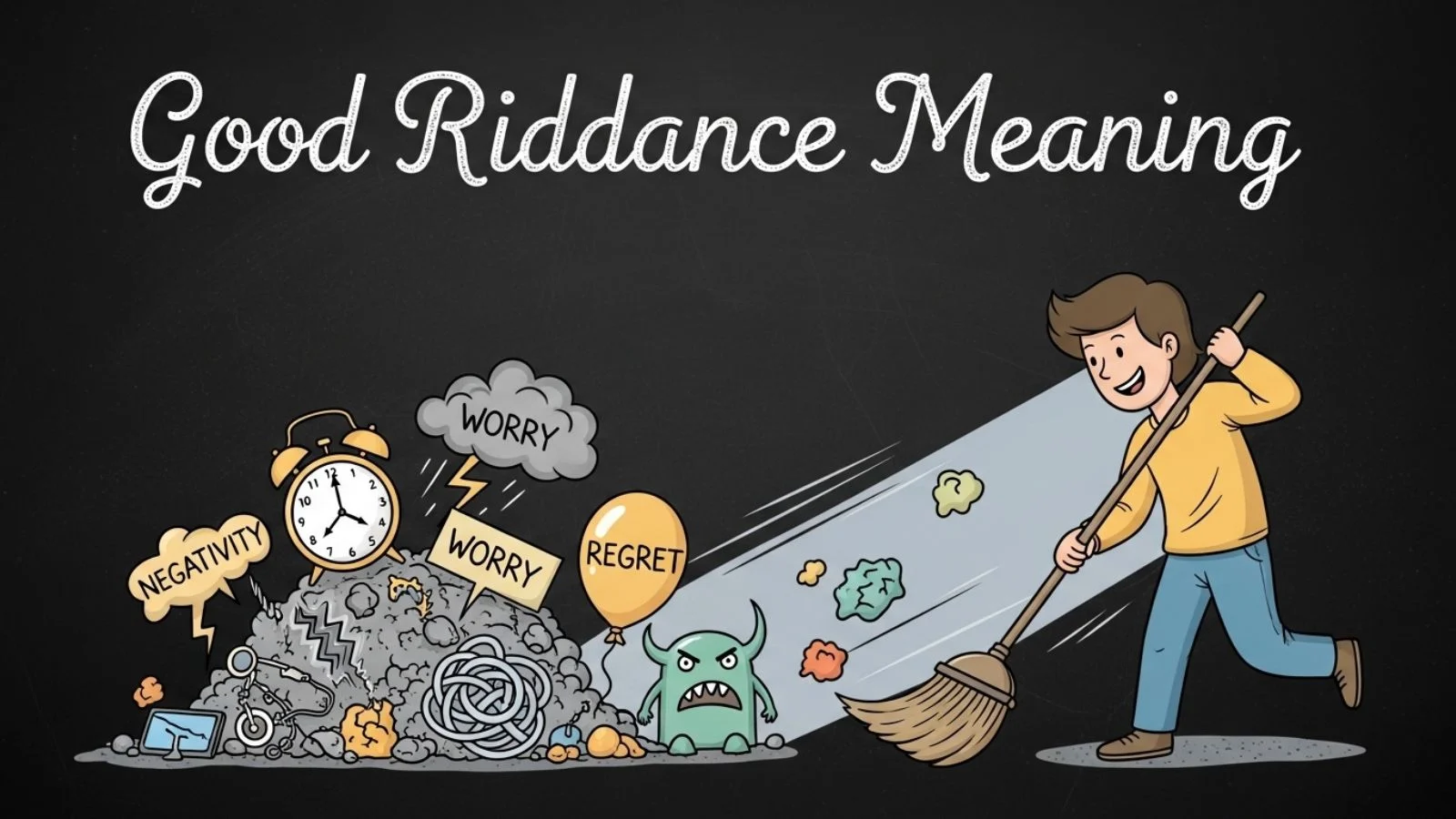
Language is powerful.
Some words show love.
Some words show anger.
And some words show relief.
The phrase “good riddance” is one of those strong expressions.
People say it when they are happy that something bad is gone.
In this complete guide, you will learn:
- The clear meaning of good riddance
- Its history and origin
- Real-life examples with short dialogues
- When to use it (and when not to)
- Common mistakes
- Modern usage in 2026
- Easy FAQs
Let’s begin.
What Does “Good Riddance” Mean?
Good riddance means:
I am glad that something or someone bad is gone.
It shows relief, not sadness.
It is often used when:
- A problem ends
- A bad situation stops
- A toxic person leaves
- Something annoying disappears
Simple Definition in Easy Words
Good riddance = Thank goodness it’s gone.
It carries a strong feeling.
It is not polite in all situations.
Breaking the Phrase: Word by Word Meaning
Let’s look at the two words.
1. Good
Here, “good” means something positive.
2. Riddance
“Riddance” means the act of getting rid of something.
So together:
Good riddance = It is good that we got rid of it.
Is “Good Riddance” Positive or Negative?
It is both.
- It is positive for the speaker
- It can feel negative or rude to others
It depends on the situation.
For example:
If someone says,
“Good riddance to that broken phone,”
it is normal.
But if someone says,
“Good riddance to her,”
it can sound harsh.
The Origin and History of “Good Riddance”
The phrase is old.
It comes from the 1500s.
One of the earliest known uses appears in a play by William Shakespeare in Troilus and Cressida (1609).
In that play, the line says:
“Good riddance.”
Even in that time, it meant relief when something bad left.
Where Does “Riddance” Come From?
The word “riddance” comes from the verb “rid.”
“Rid” means:
To free from something unwanted.
For example:
- Get rid of trash
- Rid yourself of fear
Over time, people began saying “good riddance” to show strong relief.
The meaning has stayed almost the same for 400+ years.
When Do People Use “Good Riddance”?
People use it when:
- A stressful job ends
- A toxic friendship ends
- A bad habit stops
- An annoying problem disappears
It shows:
- Relief
- Freedom
- Final closure
It is rarely used for happy or emotional goodbyes.
Real-Life Examples with Simple Explanations
Let’s look at easy examples.
Example 1: Bad Job
Ali: “I finally quit that terrible job.”
Sara: “Good riddance!”
Explanation: Sara is happy the bad job is gone.
Example 2: Broken Laptop
“I threw away that old laptop.”
“Good riddance. It never worked.”
Explanation: The laptop caused problems. Now it’s gone.
Example 3: Toxic Friend
“She always lied and created drama.”
“Good riddance.”
Explanation: The friend was harmful. The speaker feels relief.
Example 4: Old Clothes
“I donated those torn clothes.”
“Good riddance!”
Explanation: The clothes were useless and messy.
Example 5: Stressful Exam
“The final exam is over.”
“Good riddance!”
Explanation: The exam caused stress. Now it is finished.
Short Dialogues for Beginners
Dialogue 1: Office Setting
Manager: “The rude client stopped working with us.”
Employee: “Good riddance.”
Meaning: The client was difficult. Everyone feels relieved.
Dialogue 2: Home Situation
Mom: “We fixed the leaking pipe.”
Dad: “Good riddance to that problem.”
Meaning: The leak was annoying. Now it’s solved.
Dialogue 3: School
Student 1: “That mean teacher left the school.”
Student 2: “Good riddance.”
Meaning: The teacher was strict or unfair.
Personality Traits Linked to Using “Good Riddance”
People who say this phrase often:
- Speak directly
- Express strong feelings
- Do not hide emotions
- Value peace and comfort
But it can also show:
- Bitterness
- Anger
- Lack of forgiveness
So tone matters.
Formal vs Informal Usage
| Situation | Can You Say It? | Why? |
|---|---|---|
| With close friends | Yes | Casual and honest |
| On social media | Yes (carefully) | Depends on context |
| In professional emails | No | Sounds rude |
| At funerals | Never | Very disrespectful |
| About a bad product | Yes | Normal |
Modern Usage in 2026
In 2026, people use “good riddance” in:
- Tweets and posts
- Breakup captions
- Meme culture
- Online reviews
- Gaming communities
Social Media Example
“Deleted that toxic app. Good riddance.”
Explanation: The app wasted time or caused stress.
Breakup Caption (2026 Style)
“Left the drama behind. Good riddance.”
Explanation: The person feels free from relationship problems.
Gaming Example
“That bug is finally fixed. Good riddance.”
Explanation: Players were tired of the issue.
Emotional Tone: Strong or Mild?
“Good riddance” is a strong expression.
It is stronger than:
- “I’m glad it’s gone.”
- “That’s better.”
It shows deep relief.
Sometimes it can sound cold.
Common Mistakes and Misconceptions
Mistake 1: Using It for Someone Who Died
Wrong: “He passed away. Good riddance.”
This is very rude and hurtful.
Mistake 2: Using It in Formal Writing
Wrong: “The company ended the contract. Good riddance.”
Too informal and emotional.
Mistake 3: Thinking It Means Goodbye
It does not mean normal goodbye.
Wrong: “See you tomorrow. Good riddance!”
This makes no sense.
Mistake 4: Using It for Neutral Events
If something was not bad, do not use it.
Example:
“My vacation ended.”
“Good riddance.”
This sounds strange because vacation is good.
Synonyms of “Good Riddance”
Here are softer or similar phrases:
- Glad that’s over
- Thank goodness
- Finally free
- What a relief
- That’s done
Each one is softer than good riddance.
Opposite Meaning
Opposite phrases include:
- I will miss it
- That’s sad
- I wish it stayed
- I regret it
These show sadness, not relief.
Psychological Meaning Behind the Phrase
When someone says “good riddance,” it shows:
- Emotional release
- Stress removal
- Mental freedom
It often follows a long period of discomfort.
It is like saying:
“I survived that.”
Cultural Impact
The phrase appears in:
- Movies
- TV shows
- Books
- Song lyrics
It is popular in English-speaking countries.
It is common in:
- United States
- United Kingdom
- Canada
- Australia
It is understood worldwide now due to social media.
Tone Differences: Angry vs Calm Usage
Angry Tone
“Good riddance! I never liked him anyway.”
This sounds bitter.
Calm Tone
“Good riddance. That chapter is closed.”
This sounds peaceful and relieved.
Can “Good Riddance” Be Funny?
Yes.
People use it in jokes.
Example:
“My alarm clock broke.”
“Good riddance.”
Explanation: Nobody likes waking up early.
Workplace Context: Should You Use It?
Be careful.
In meetings, avoid it.
Instead say:
- “That issue is resolved.”
- “We’re glad it’s completed.”
“Good riddance” may sound unprofessional.
Relationship Context
After breakups, people use it often.
But if emotions are still sensitive, it may cause conflict.
Better options:
- “It wasn’t right for us.”
- “We both needed space.”
Table: Quick Summary
| Feature | Meaning |
|---|---|
| Type | Idiomatic expression |
| Emotion | Relief |
| Tone | Strong |
| Formality | Informal |
| First known use | 1600s |
| Used for | Bad situations ending |
Why Is It Still Popular in 2026?
Because:
- People like short strong phrases
- It fits social media captions
- It expresses clear emotion
- It is dramatic and memorable
In fast digital communication, strong short phrases win.
Frequently Asked Questions
1. Is “good riddance” rude?
It can be. It depends on tone and situation. It sounds harsh if used about people.
2. Can I say “good riddance” at work?
It is better not to. Use softer words in professional settings.
3. Does it mean goodbye?
No. It means relief that something bad is gone.
4. Is it old-fashioned?
No. It is still common in 2026, especially online.
5. Can I use it in writing?
Yes, in informal writing like blogs or social media. Avoid formal reports.
6. Is it always negative?
No. It feels positive to the speaker but may sound negative to others.
7. Can children use this phrase?
Yes, but they should understand it may sound strong or rude.
Final Thoughts on “Good Riddance”
The phrase good riddance is simple but powerful. It means you are happy something bad is gone. It shows relief, freedom, and emotional release. The phrase has existed for over 400 years and is still popular in 2026, especially online. However, it can sound harsh if used carelessly. Always think about tone, setting, and audience before saying it. Use it in casual conversations, not in formal situations. When used wisely, it clearly expresses strong relief and closure.
If you want to master more everyday English phrases, keep learning and practicing simple real-life expressions daily.
Discover More Post
Nonge Meaning: Clear Definition, Origin, Usage, and Real-Life Examples
Ohio Slang Meaning: Simple Definition, Origin, Examples, and 2026 Usage Guide
El Gallo Meaning: Simple Definition, Origin, Slang Use & Real Examples