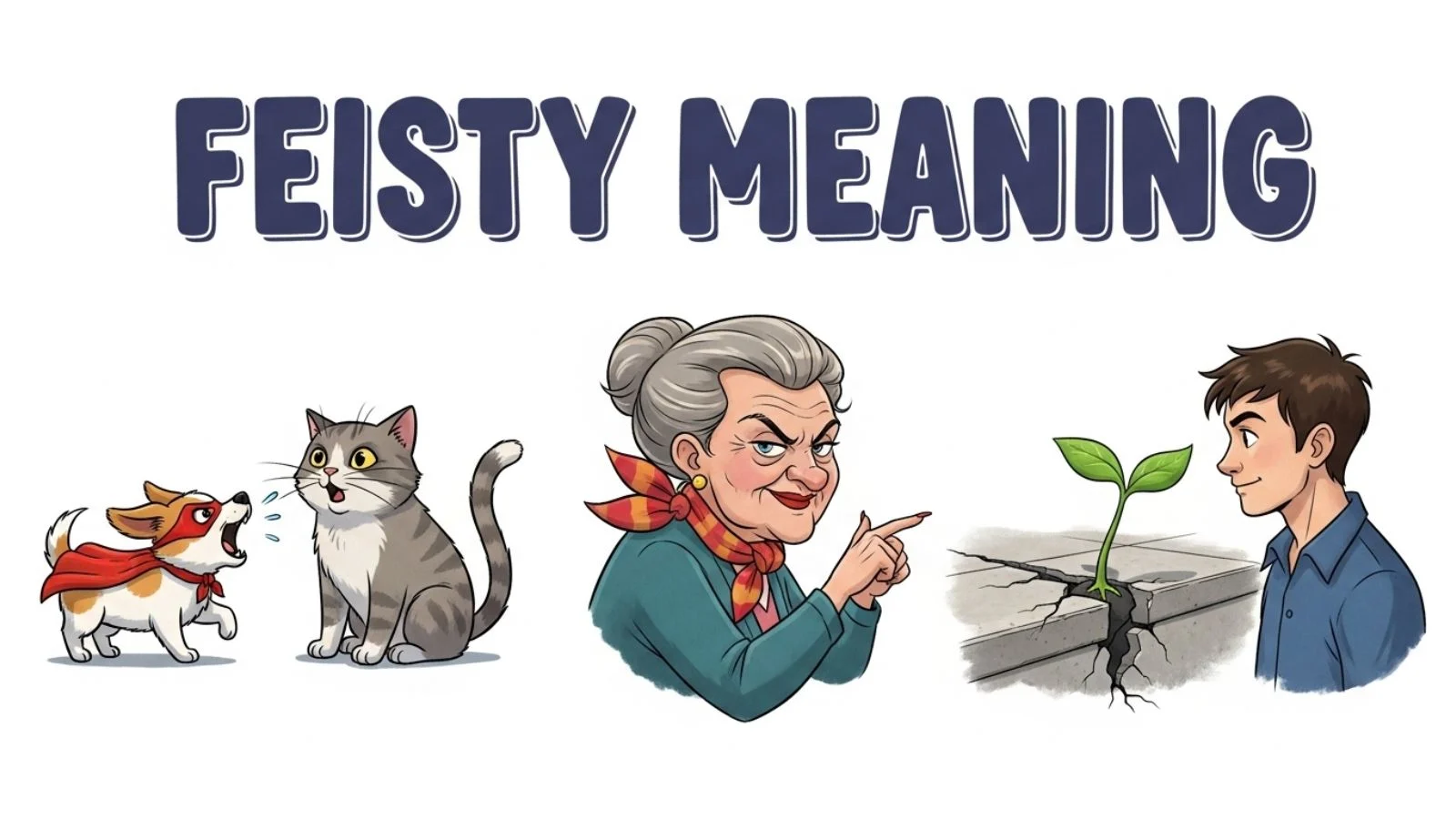
The word feisty is small, but it has strong energy.
People use it to describe someone who is bold, lively, and ready to stand up for themselves.
In this complete guide, you will learn the feisty meaning in simple words. You will also see real-life examples, short dialogues, personality traits, common mistakes, and modern usage updated for 2026.
This article is written in very simple English so beginners can understand easily.
What Does Feisty Mean?
The word feisty describes a person or animal who is:
- Full of energy
- Brave
- Lively
- Quick to argue
- Ready to defend themselves
Simple Definition of Feisty
Feisty means being bold, energetic, and not afraid to speak up.
A feisty person does not stay quiet when something feels wrong. They speak strongly. They show spirit.
One-Line Meaning
A feisty person is someone small or young who shows big courage and attitude.
Feisty Meaning in Easy Words
Let us break it down even more simply.
Imagine a small dog that barks loudly at a bigger dog.
That dog is feisty.
Imagine a young girl who confidently answers back when someone teases her.
She is feisty.
The word often describes:
- Someone who is confident
- Someone who argues quickly
- Someone who has strong feelings
Feisty does not always mean angry. It means full of fire and spirit.
Origin and History of the Word Feisty
Understanding a word’s history helps you remember it better.
The word feisty comes from the word “feist.”
What Is “Feist”?
In the past, especially in American English, a feist meant:
- A small dog
- A noisy dog
Later, people began using feisty to describe people who act like that small, energetic dog.
When Did It Become Popular?
- The word became common in the 1800s in the United States.
- Over time, it spread to other English-speaking countries.
- Today in 2026, it is widely used in daily conversations and online posts.
So, the word started with dogs but now mostly describes people with strong personalities.
Is Feisty Positive or Negative?
This is an important question.
The word feisty can be:
- Positive
- Slightly negative
- Neutral
It depends on tone and situation.
When Feisty Is Positive
It means:
- Brave
- Confident
- Strong
- Independent
Example:
“She is a feisty leader.”
This means she is strong and not afraid.
When Feisty Is Slightly Negative
It can mean:
- Too argumentative
- Easily angry
- Too stubborn
Example:
“He is feisty in meetings.”
This may mean he argues too much.
So always check the context.
Personality Traits of a Feisty Person
Here are common traits of a feisty personality:
- Strong opinions
- Quick reactions
- High energy
- Confidence
- Bold speech
- Emotional intensity
- Protective nature
Feisty people often:
- Defend friends
- Speak up in class
- Challenge unfair rules
- Refuse to stay silent
They are not weak. They are spirited.
Real-Life Examples of Feisty (With Simple Explanation)
Below are practical examples. Each one includes a short explanation so beginners can understand clearly.
Example 1
“She gave a feisty reply to the rude comment.”
Explanation:
She answered strongly instead of staying quiet.
Example 2
“The small puppy was feisty and playful.”
Explanation:
The puppy was energetic and not afraid.
Example 3
“My grandmother is 75 but still feisty.”
Explanation:
Even at her age, she is bold and lively.
Example 4
“The actress is known for her feisty personality.”
Explanation:
She speaks confidently and acts strongly.
Example 5
“The team showed a feisty performance.”
Explanation:
The team played with strong energy and courage.
Short Dialogues Using Feisty
Dialogues help you understand how native speakers use words naturally.
Dialogue 1: At School
Ali: “Why did Sara argue with the teacher?”
Ahmed: “She’s feisty. She doesn’t stay quiet when she disagrees.”
Explanation:
Sara is bold and speaks up.
Dialogue 2: At Work
Manager: “We need new ideas.”
Aisha: “I disagree with this plan.”
Colleague: “That’s her feisty side.”
Explanation:
She confidently shares her opinion.
Dialogue 3: About a Child
Mother: “My daughter is so feisty.”
Friend: “That’s good. She will grow up strong.”
Explanation:
The child is brave and confident.
Feisty vs Similar Words
Let us compare feisty with other words.
| Word | Meaning | Difference from Feisty |
|---|---|---|
| Bold | Not afraid | Bold may not argue |
| Brave | Not scared | Brave focuses on fear |
| Aggressive | Pushy or forceful | Aggressive is stronger and more negative |
| Lively | Full of energy | Lively may not argue |
| Spirited | Energetic and brave | Very close meaning |
Feisty combines energy + courage + quick reactions.
When to Use the Word Feisty
Use feisty in these situations:
- Describing a confident person
- Talking about strong reactions
- Praising someone’s courage
- Describing pets
- Writing stories or character descriptions
It is common in:
- Conversations
- Social media posts
- Movies and TV shows
- Personality descriptions
Modern Usage of Feisty in 2026
Language changes with time. In 2026, the word feisty is popular in:
1. Social Media
People write:
- “She’s small but feisty.”
- “Feisty energy today.”
- “Stay feisty.”
It often means confident and powerful.
2. Workplace Culture
Managers use it to describe employees who:
- Speak up in meetings
- Challenge ideas
- Show leadership qualities
Example:
“We need more feisty thinkers on this team.”
Explanation:
The team needs bold and confident people.
3. Pop Culture
TV characters are described as:
- Feisty heroines
- Feisty best friends
- Feisty competitors
It usually means strong female characters who are not passive.
4. Online Dating Profiles
Some people describe themselves as:
“Fun, friendly, and a little feisty.”
Explanation:
They mean they are confident and playful.
Common Mistakes About Feisty
Many learners misunderstand this word.
Here are common mistakes:
Mistake 1: Thinking Feisty Means Angry
Feisty does not always mean angry.
It means energetic and bold.
Mistake 2: Thinking Feisty Is Always Negative
It is often positive.
It can show strength and independence.
Mistake 3: Using It for Calm People
A quiet and peaceful person is not feisty.
Feisty people show visible energy.
Mistake 4: Confusing It With Aggressive
Aggressive means forceful and sometimes harmful.
Feisty is lighter and often playful.
Is Feisty Used More for Women?
Yes, often.
The word is commonly used to describe:
- Young girls
- Female leaders
- Women in movies
But it can also describe:
- Men
- Boys
- Pets
- Sports teams
In modern language, it applies to anyone with strong energy.
Cultural View of Feisty
In many cultures, being feisty is seen as:
- A sign of confidence
- A sign of independence
- A sign of leadership
However, in some traditional settings, feisty behavior may be seen as:
- Too bold
- Disrespectful
So always consider culture and context.
How to Use Feisty in Sentences Correctly
Here are sentence patterns:
- She is feisty.
- He gave a feisty answer.
- The puppy looks feisty.
- They had a feisty debate.
Notice that feisty is usually an adjective.
Simple Grammar Tip
Feisty is an adjective.
It describes:
- A person
- An animal
- A response
- A performance
Example:
“Her feisty attitude impressed everyone.”
Attitude is a noun. Feisty describes it.
More Example Sentences with Explanations
1. “The toddler gave a feisty shout.”
Explanation:
The small child shouted boldly.
2. “He made a feisty comeback.”
Explanation:
He returned strongly after losing.
3. “She has a feisty spirit.”
Explanation:
She is naturally bold and energetic.
4. “The debate became feisty.”
Explanation:
People argued strongly and emotionally.
5. “My cat is small but feisty.”
Explanation:
The cat is tiny but brave.
When Not to Use Feisty
Avoid using feisty:
- In formal legal writing
- In serious medical reports
- In academic research papers
It is mostly informal and conversational.
Why People Like the Word Feisty
People like this word because it shows:
- Strength
- Confidence
- Personality
- Energy
It is short but powerful.
It makes descriptions more interesting.
Instead of saying “She is strong,”
You can say, “She is feisty.”
FAQs About Feisty Meaning
1. Is feisty a compliment?
Yes, usually it is a compliment. It praises someone’s bold and confident nature.
2. Does feisty mean rude?
Not exactly. It means energetic and outspoken, but sometimes it can sound slightly rude if someone argues too much.
3. Can men be called feisty?
Yes. Anyone with bold and spirited behavior can be described as feisty.
4. Is feisty the same as aggressive?
No. Aggressive is stronger and more negative. Feisty is lively and spirited.
5. Can a child be feisty?
Yes. Many children are described as feisty when they speak confidently and show strong personality.
6. Is feisty good in the workplace?
It can be good if it means confident and assertive. But too much feisty behavior may create conflict.
7. What is a feisty comeback?
It is a bold and quick reply, often after someone criticizes you.
Final Thoughts on Feisty Meaning
The word feisty is full of life. It describes someone who is bold, energetic, and not afraid to speak up. It started as a word for small, lively dogs, but today it mostly describes people with strong personalities. In modern 2026 English, feisty often has a positive meaning. It shows courage, confidence, and independence. However, tone and context are important. Used correctly, this word can make your English more powerful and expressive. Keep practicing with real examples, and soon you will use feisty naturally in daily conversation.
Discover More Post
Nymphology Meaning: Simple Definition, Origin, Examples, and Modern Usage (2026)
Good Riddance Meaning: Simple Definition, Origin, Examples & Modern Usage (2026 Guide)
Nonge Meaning: Clear Definition, Origin, Usage, and Real-Life Examples