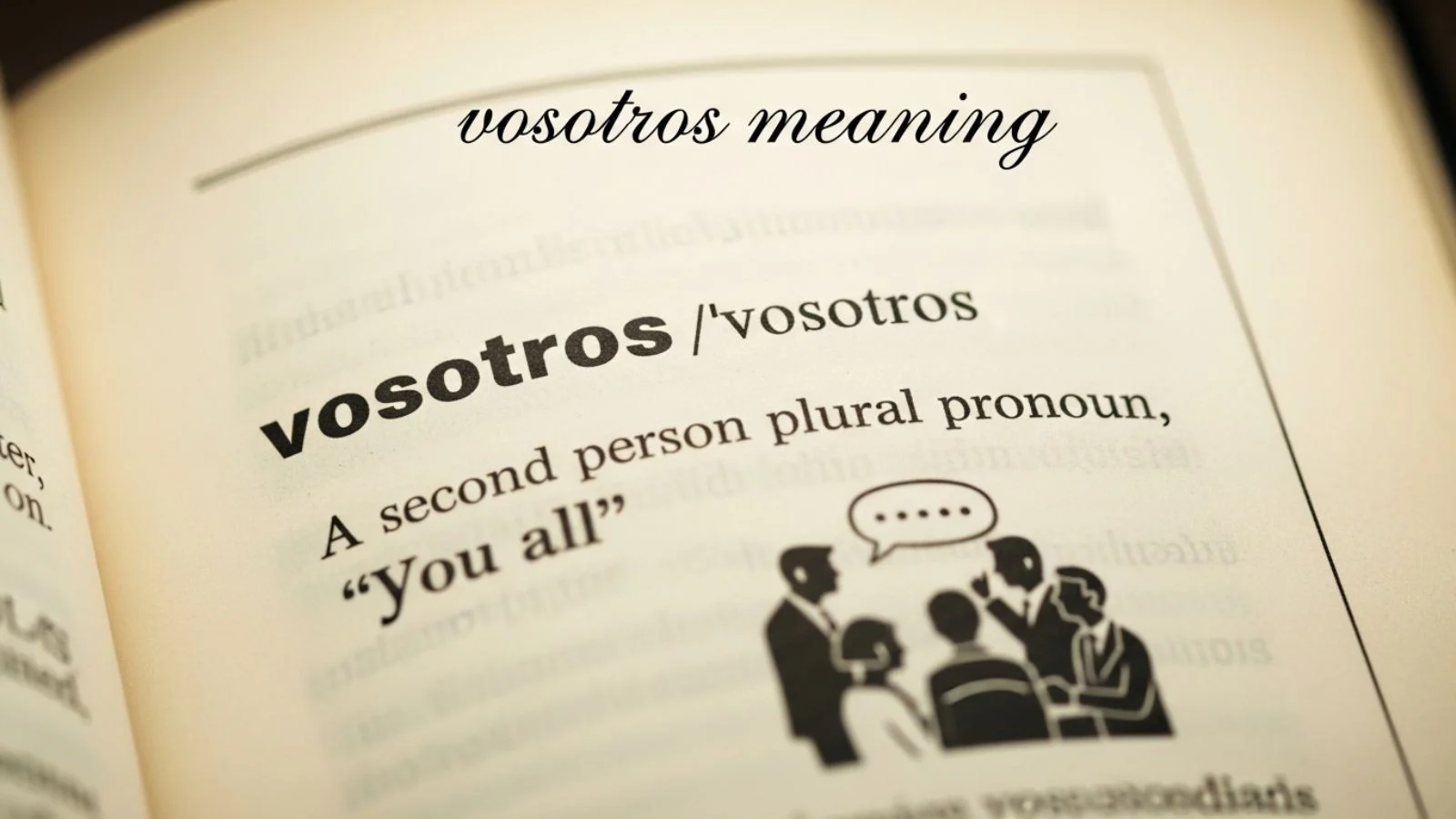
If you are learning Spanish, you may have seen the word vosotros and felt confused.
Is it the same as “you”?
Is it formal or informal?
Do people still use it in 2026?
In this complete guide, I will explain the vosotros meaning in very simple English. You will learn:
- What vosotros means
- Where it is used
- How to use it with verbs
- Real-life examples and short dialogues
- Common mistakes
- Modern usage in 2026
- FAQs beginners often ask
This article follows expert language teaching methods and Google’s Helpful Content guidelines. Everything is clear, correct, and beginner-friendly.
Let’s begin.
What Does Vosotros Mean?
Vosotros means “you all” in Spanish.
It is used when you talk to more than one person.
But there is something important:
- It is informal
- It is mainly used in Spain
- It is not commonly used in Latin America
Simple Definition
Vosotros = you (plural, informal)
In easy words:
If you are speaking to a group of friends in Spain, you use vosotros.
Vosotros vs Other “You” Words in Spanish
Spanish has different words for “you.” This is why learners feel confused.
Here is a simple table:
| Spanish Word | Meaning | Singular/Plural | Formal/Informal | Used In |
|---|---|---|---|---|
| Tú | You | Singular | Informal | All Spanish-speaking countries |
| Usted | You | Singular | Formal | All Spanish-speaking countries |
| Vosotros | You all | Plural | Informal | Mostly Spain |
| Ustedes | You all | Plural | Formal (Spain) / Both (Latin America) | All countries |
Important Rule
- In Spain:
- Informal plural = vosotros
- Formal plural = ustedes
- In Latin America:
- Both formal and informal plural = ustedes
This is a very important difference.
Origin and History of Vosotros
To understand vosotros meaning, we should look at history.
The word vosotros comes from:
- Latin word “vos” meaning “you (plural)”
- Combined with “otros” meaning “others”
So originally:
Vosotros = you others
Over time, Spanish grammar changed. In Spain, vosotros stayed common. But in Latin America, people slowly stopped using it. They began using ustedes for all plural situations.
Why?
Because of language simplification during colonization and cultural change.
Today in 2026:
- In Spain, children still learn and use vosotros
- In Mexico, Argentina, Colombia, and most of Latin America, people do not use it in daily speech
Where Is Vosotros Used Today? (Updated for 2026)
1. Spain
In Spain, vosotros is normal and common.
Friends, classmates, siblings, coworkers (informal setting) use it daily.
Example:
- ¿Vosotros vais al cine?
This means:
- Are you all going to the cinema?
2. Latin America
In most Latin American countries:
- Vosotros is rarely used
- It may appear in textbooks
- It may appear in Bible translations
- But people speak using ustedes
Example in Mexico:
- ¿Ustedes van al cine?
Same meaning, different word.
Vosotros Verb Conjugation (Very Important)
When you use vosotros, the verb changes.
This is what makes learners nervous. But don’t worry.
Present Tense Endings
For regular verbs:
- AR verbs → -áis
- ER verbs → -éis
- IR verbs → -ís
Let’s look at examples.
Example 1: Hablar (to speak)
Vosotros form:
- Vosotros habláis
Meaning:
- You all speak
Explanation:
We remove -ar and add -áis.
Example 2: Comer (to eat)
Vosotros coméis
Meaning:
- You all eat
Explanation:
Remove -er and add -éis.
Example 3: Vivir (to live)
Vosotros vivís
Meaning:
- You all live
Explanation:
Remove -ir and add -ís.
Real-Life Examples with Simple Explanations
Let’s see easy examples beginners understand.
Example 1
Vosotros sois mis amigos.
Meaning:
You all are my friends.
Explanation:
“Sois” is the vosotros form of “ser” (to be).
Example 2
Vosotros tenéis tarea.
Meaning:
You all have homework.
Explanation:
“Tenéis” is the vosotros form of “tener”.
Example 3
¿Por qué vosotros llegáis tarde?
Meaning:
Why are you all arriving late?
Explanation:
“Llegáis” follows the AR rule (-áis).
Short Dialogues (Beginner-Friendly)
Dialogue 1 – In Spain
Teacher: ¿Vosotros entendéis la lección?
Students: Sí, entendemos.
Meaning:
Teacher asks, “Do you all understand the lesson?”
Explanation:
Teacher speaks to many students informally.
Dialogue 2 – Friends Planning
Ana: ¿Vosotros vais a la fiesta?
Carlos: Sí, vamos todos.
Meaning:
Ana asks, “Are you all going to the party?”
Explanation:
She is speaking to a group of friends.
Dialogue 3 – At Home
Mother: ¿Vosotros limpiáis vuestra habitación?
Children: Sí, mamá.
Meaning:
“Do you all clean your room?”
Explanation:
Mother talks to more than one child.
Personality Traits and Usage Context
Language shows personality.
Using vosotros often suggests:
- Casual tone
- Friendly atmosphere
- Informal relationship
- Equal social level
You would not use vosotros:
- In a formal business meeting (Spain)
- When speaking respectfully to elders
- In official speeches
Instead, you would use ustedes in formal settings.
Vosotros in Modern Life (2026 Examples)
In 2026, Spanish learners see vosotros in:
1. Netflix Spain Shows
Spanish TV series use it naturally.
Example:
- ¿Qué hacéis aquí?
Meaning:
What are you all doing here?
2. YouTube Creators in Spain
Spanish influencers say:
- Hola chicos, ¿cómo estáis?
Meaning:
Hello guys, how are you all?
Explanation:
“Estáis” is vosotros form of “estar”.
3. Video Games (Spain Region)
Game instructions:
- Elegid vuestra arma.
Meaning:
Choose your weapon (you all).
Explanation:
Imperative plural informal.
Vosotros in Imperative (Commands)
When giving commands to a group in Spain:
AR → -ad
ER → -ed
IR → -id
Example:
Hablar → Hablad
Meaning: Speak (you all)
Comer → Comed
Meaning: Eat (you all)
Vivir → Vivid
Meaning: Live (you all)
Common Mistakes About Vosotros
Many learners make these errors.
Mistake 1: Using Vosotros in Mexico
Wrong:
Vosotros vais a la tienda. (in Mexico)
Correct:
Ustedes van a la tienda.
Explanation:
Mexico does not use vosotros in daily speech.
Mistake 2: Mixing Vosotros with Ustedes Verb
Wrong:
Vosotros van al parque.
Correct:
Vosotros vais al parque.
Explanation:
Verb must match pronoun.
Mistake 3: Thinking It Is Formal
Vosotros is NOT formal.
It is informal plural.
Mistake 4: Ignoring It in Spanish Learning
Some learners skip it.
But if you watch Spanish shows or visit Spain, you must understand it.
Should You Learn Vosotros in 2026?
It depends on your goal.
Learn Vosotros If:
- You plan to live in Spain
- You watch Spanish content from Spain
- You want full grammar knowledge
- You prepare for European Spanish exams
You Can Skip It If:
- You focus only on Latin American Spanish
- You only speak with Mexican or Colombian speakers
But understanding it is always helpful.
Quick Comparison: Vosotros vs Ustedes
| Situation | Spain Informal | Spain Formal | Latin America |
|---|---|---|---|
| Talking to friends | Vosotros | — | Ustedes |
| Talking to boss | — | Ustedes | Ustedes |
| Talking to strangers | — | Ustedes | Ustedes |
Why Textbooks Still Teach Vosotros
Many global Spanish books teach standard grammar.
Standard grammar includes:
- Tú
- Usted
- Vosotros
- Ustedes
Even if not used everywhere, it is part of official Spanish structure.
Memory Trick for Beginners
To remember vosotros:
Think:
Vosotros = “you others”
Also remember:
-áis
-éis
-ís
These endings are special signals.
FAQs About Vosotros Meaning
1. Is vosotros used in Mexico?
No. In Mexico, people use ustedes for plural “you.”
2. Is vosotros formal or informal?
It is informal plural.
3. Do I need to learn vosotros?
Yes, if you study Spain Spanish. Optional for Latin America focus.
4. What is the vosotros form of “ser”?
Vosotros sois.
Meaning:
You all are.
5. Why do Spanish movies use vosotros?
Because many films are produced in Spain.
6. Can I ignore vosotros in conversation?
If you speak only Latin American Spanish, yes. But you should understand it when hearing it.
Final Summary: Vosotros Meaning in Simple Words
Vosotros means “you all” (informal plural) in Spanish.
It is:
- Used mainly in Spain
- Informal
- Paired with special verb endings
- Rare in Latin America
Learning vosotros helps you:
- Understand Spain Spanish
- Watch Spanish shows easily
- Speak naturally with Spanish friends
Spanish becomes easier when you understand patterns. Vosotros may look difficult at first, but it follows clear rules.
If you are serious about learning Spanish, take time to practice vosotros forms. Read, listen, and repeat examples daily. With practice, it will feel natural and simple. Keep learning step by step, and your Spanish will grow stronger every day.
Discover More Post
IMAO Meaning: Clear Definition, Origin, Examples & How to Use It (2026 Guide)
Lowkey Meaning: Simple Definition, Origin, Examples, and Modern Usage (2026 Guide)
Whether Meaning in English: Simple Definition, Examples, Origin, and Usage Guide (2026)