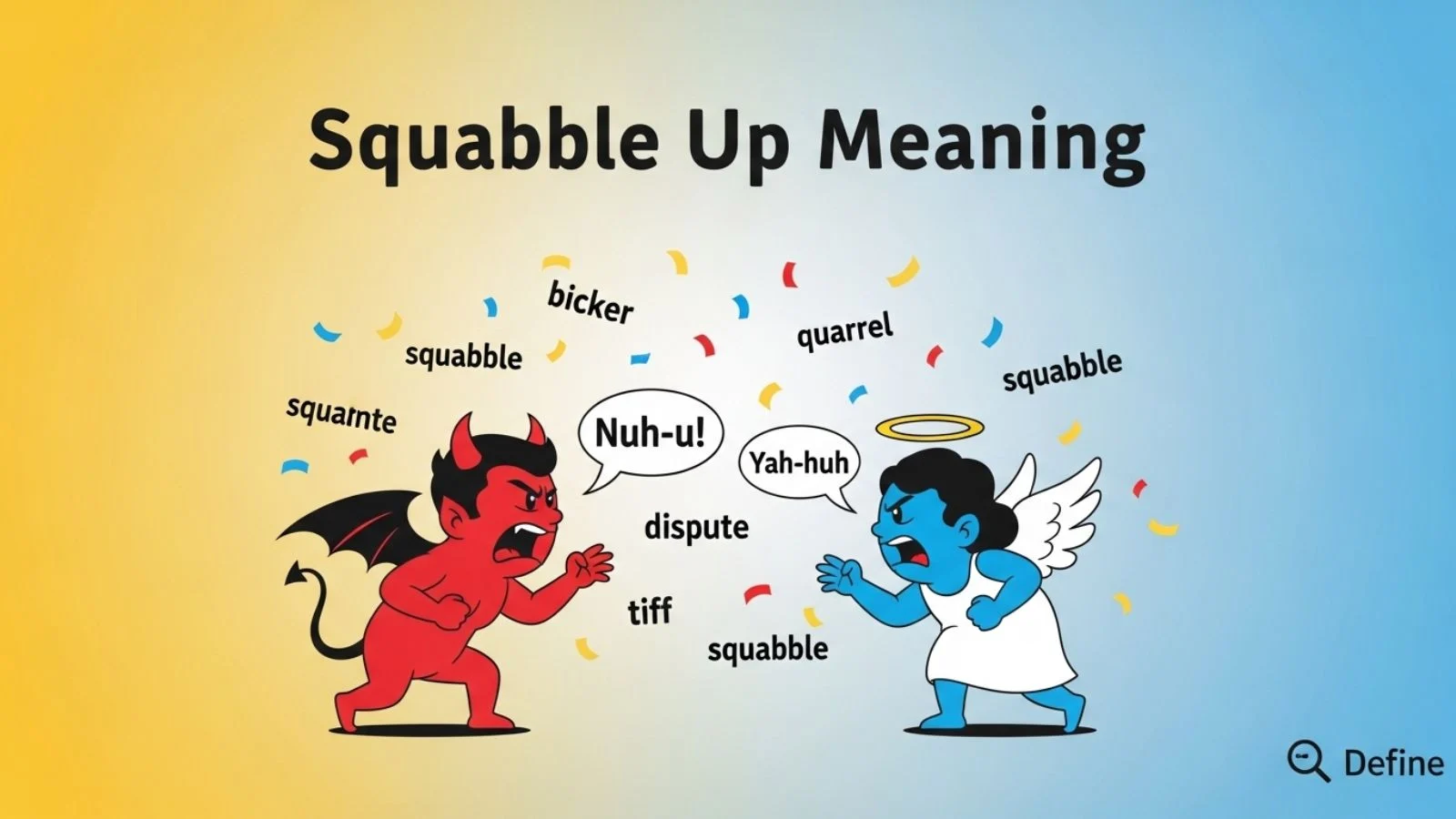
The phrase “squabble up” is an informal expression used in English. It means:
To start a small argument, fight, or noisy disagreement with someone.
In very simple words, when people “squabble up,” they begin to argue or quarrel over something small or unimportant.
A squabble is not a serious fight. It is usually:
- Small
- Loud or emotional
- About minor issues
- Short in time
So, “squabble up” = to get into a small, silly argument quickly.
Simple Definition (Grade 3 Level)
Squabble up means to start arguing in a noisy and small way with someone.
Origin and History of “Squabble Up”
The word “squabble” has been used in English for hundreds of years. It comes from older English words that meant noisy fighting or complaining.
Word Breakdown:
- Squabble = a small argument
- Up = used to show action or starting something (informal usage)
So, “squabble up” developed in informal English, especially in spoken language, where people add “up” to verbs for emphasis.
How It Became Popular:
- Used in casual conversations
- Spread through social media and slang
- Common in storytelling, movies, and street language
Today, it is mostly used in informal speech, not in formal writing.
How “Squabble Up” Is Used Today (2026 Update)
In 2026, English slang has become more casual due to:
- Social media platforms
- Short video content
- Messaging apps
People now use “squabble up” when:
- Friends argue over small things
- Family members disagree loudly
- Children fight over toys
- Couples have minor disagreements
It is not a serious term. It is often used in a funny or light way.
Personality Traits Linked to “Squabble Up”
People who often “squabble up” may show these behaviors:
Common Traits:
- Easily annoyed over small things
- Talkative during arguments
- Quick to react emotionally
- Not staying calm in disagreement
- Forget issues quickly after arguing
Important Note:
This does NOT mean a person is bad. It only describes behavior in small arguments.
Real-Life Examples of “Squabble Up”
Example 1: Friends
Two friends squabble up over food choice.
Explanation: They argue because one wants pizza and the other wants burgers. The fight is small and not serious.
Example 2: Siblings
Brother and sister squabble up about TV control.
Explanation: They both want to watch different shows, so they argue loudly for a short time.
Example 3: School Students
Students squabble up about group work roles.
Explanation: They disagree about who should do which task, but the issue is not serious.
Short Dialogues Using “Squabble Up”
Dialogue 1: Friends
A: Why are you squabbling up again?
B: He took my seat!
Explanation: They are having a small argument over a seat.
Dialogue 2: Family
Mother: Stop squabbling up and share the toy.
Kids: Okay, we will share.
Explanation: The mother is asking children to stop arguing.
Dialogue 3: School
Teacher: Don’t squabble up in class.
Students: Sorry, teacher.
Explanation: The teacher is stopping small classroom fights.
Table: Where “Squabble Up” Is Commonly Used
| Situation | Example Issue | Level of Seriousness |
|---|---|---|
| Friends | Food choice | Low |
| Family | TV remote | Low |
| School | Group tasks | Low |
| Online chats | Opinions | Low |
| Work (informal) | Small misunderstandings | Low |
Common Mistakes and Misconceptions
Many learners misunderstand the phrase “squabble up.”
Mistake 1: Thinking it means serious fight
Wrong: It means physical violence
Correct: It means a small argument
Mistake 2: Using it in formal writing
Wrong: Business reports or essays
Correct: Only casual speech or messages
Mistake 3: Confusing with “fight”
Fight is serious
Squabble up is small and silly
Modern Usage Examples (2026)
In 2026 digital communication, people use it like this:
Example 1: Social Media Chat
“They always squabble up in comments.”
Explanation: People argue in comment sections online.
Example 2: Gaming Chat
“Don’t squabble up over loot.”
Explanation: Players argue about game rewards.
Example 3: Friendship Groups
“We squabble up but we’re still best friends.”
Explanation: Friends argue but stay close.
Situations Where You Should NOT Use “Squabble Up”
- Job interviews
- Formal emails
- Academic essays
- Legal writing
- Professional reports
Why?
Because it is informal slang, not formal English.
Synonyms of “Squabble Up”
Here are simple words with similar meaning:
- Argue
- Bicker
- Disagree
- Quarrel
- Fight (small)
- Row (British English informal)
Comparison Table: Squabble vs Fight
| Word | Meaning | Seriousness |
|---|---|---|
| Squabble | Small argument | Low |
| Fight | Physical or strong argument | High |
| Debate | Calm discussion | Medium |
Why People Squabble Up
People often squabble up because:
- They feel annoyed
- They want attention
- They misunderstand each other
- They compete for small things
- They are emotional
Important Insight:
Most squabbles end quickly without long-term issues.
Common Contexts of Usage
- Family homes
- Classrooms
- Friend groups
- Online chats
- Gaming communities
Emotional Impact of Squabbling
Even though it is small, squabbling can cause:
- Temporary anger
- Misunderstanding
- Short-term silence
- Quick resolution after cooling down
But it usually does NOT cause serious harm.
Tips to Avoid Squabbling Up
- Stay calm during disagreement
- Listen carefully
- Do not react too fast
- Share fairly
- Talk politely
Advanced Understanding (Simple Explanation)
In linguistics, “squabble up” is an informal phrasal expression formed by:
- A noun/verb root (squabble)
- A directional particle (up)
This structure is common in English slang to make actions sound more dynamic.
FAQs About “Squabble Up Meaning”
1. What does squabble up mean in simple English?
It means to start a small and noisy argument with someone.
2. Is squabble up a formal word?
No, it is informal slang used in casual conversations only.
3. Is squabbling up a serious fight?
No, it is usually a small disagreement, not a serious fight.
4. Can I use squabble up in writing?
You can use it in stories or dialogues, but not in formal writing.
5. What is the difference between squabble and argue?
Squabble is small and emotional, while argue can be more serious.
6. Where is squabble up commonly used?
It is used in chats, social media, family talk, and among friends.
7. Is squabble up still used in 2026?
Yes, it is still used in informal English, especially online and in casual speech.
Conclusion
The phrase “squabble up” simply means to start a small and usually unimportant argument. It is commonly used in informal English when people disagree over minor things like food, toys, or opinions. The expression is not serious and often ends quickly without long-term issues. In modern 2026 communication, it is widely seen in chats, social media, and casual conversations. Understanding this phrase helps learners improve their English slang knowledge and daily communication skills. If you want to sound more natural in informal English, learning expressions like “squabble up” can be very helpful for real-life conversations and online interactions.
Discover More Post
PACU Meaning: Full Explanation, Origin, Examples, and Uses (2026 Guide)
CPN Meaning: Full Simple Guide for Beginners (2026 Updated)
Black Heart Emoji Meaning: Full Guide, Uses, Examples & Hidden Meanings (2026)