Understanding new English words can feel hard. But it does not have to be.
In this guide, you will learn the glib meaning in very simple words. You will also learn where it came from, how to use it, real-life examples, personality traits linked to it, and common mistakes.
This article is written in easy English so anyone can understand it.
Let’s begin.
What Does Glib Mean?
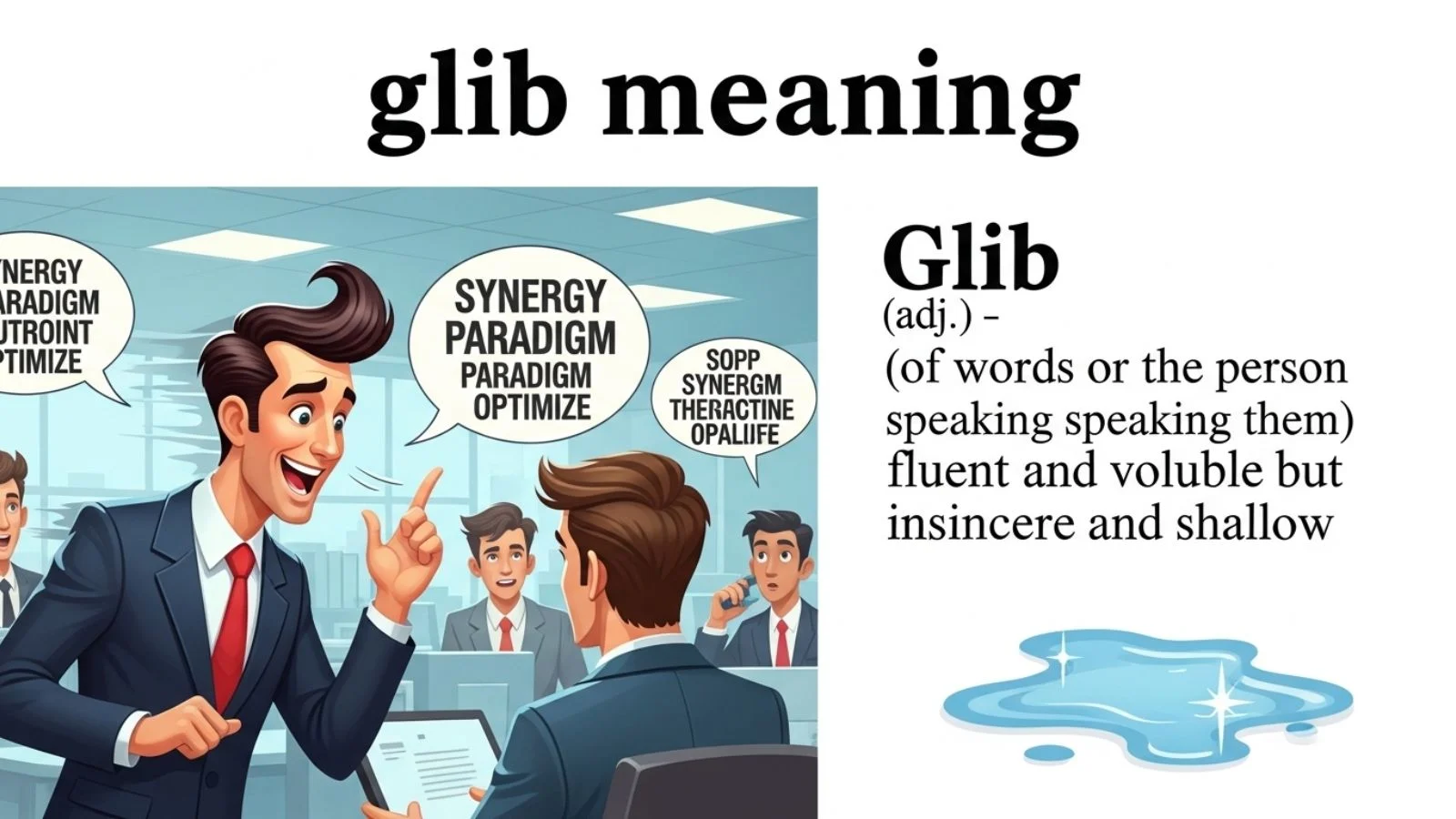
Glib means speaking in a smooth, easy, and confident way — but often without deep thought or honesty.
A glib person sounds smart and charming. But their words may feel shallow, careless, or not serious.
Simple Definition (Grade 3–4 Level)
Glib means talking smoothly and quickly in a way that sounds nice but may not be true or thoughtful.
Glib Meaning in One Sentence
A glib person speaks easily and confidently but may not think deeply about what they are saying.
Is Glib Positive or Negative?
Most of the time, glib is negative.
It suggests:
- The speaker is not serious
- The words are shallow
- The person may not care deeply
But sometimes, it can simply describe someone who speaks very smoothly.
Origin and History of the Word Glib
The word glib comes from old English and Scottish roots.
Where Did It Come From?
- 14th century Scottish word: glib
- Meaning back then: smooth or slippery
- Later meaning: smooth in speech
Over time, the meaning changed from “physically smooth” to “smooth in talking.”
This shift is common in English. Words often move from physical meaning to personality meaning.
Easy Synonyms of Glib
Here are some words similar to glib:
- Smooth-talking
- Slick
- Fast-talking
- Fluent
- Charming (sometimes)
- Superficial
Important Note
Not all synonyms are negative. But glib usually has a negative tone.
Simple Table: Glib vs Similar Words
| Word | Meaning | Positive or Negative? |
|---|---|---|
| Glib | Smooth but shallow speech | Mostly negative |
| Fluent | Speaks easily and clearly | Positive |
| Charming | Pleasant and likable | Positive |
| Slick | Smooth but sometimes dishonest | Often negative |
| Confident | Sure of oneself | Positive |
This table helps you see how glib is different.
Real-Life Examples of Glib
Let’s look at clear examples.
Example 1
Rina gave a glib answer about climate change without knowing any facts.
Explanation: She spoke confidently, but she did not understand the topic.
Example 2
The salesman gave a glib speech about the product.
Explanation: He talked smoothly, but maybe he did not tell the full truth.
Example 3
His glib apology did not feel real.
Explanation: He said sorry quickly, but it did not sound sincere.
Example 4
The student gave a glib reply during the serious discussion.
Explanation: The student did not treat the topic seriously.
Short Dialogues Using Glib
Dialogue 1: In School
Teacher: Why did you not finish your homework?
Student: Oh, I was just too busy saving the world.
Teacher: That glib answer is not funny. Please be serious.
Explanation: The student joked instead of giving a real answer.
Dialogue 2: At Work
Boss: Why did the project fail?
Employee: Well, sometimes things just happen.
Boss: That sounds glib. I need a real reason.
Explanation: The employee avoided giving a serious explanation.
Dialogue 3: Political Debate
Reporter: How will you fix unemployment?
Politician: We will create amazing jobs very quickly.
Reporter: That answer feels glib. Can you explain how?
Explanation: The answer sounds nice but lacks details.
Personality Traits of a Glib Person
A glib person may show these traits:
- Speaks very smoothly
- Talks fast
- Sounds confident
- Uses big words
- Avoids deep explanation
- May not think carefully
Important
Not all smooth talkers are glib.
The key difference is lack of depth or sincerity.
When Is Glib Used?
You use glib when:
- Someone makes light of serious issues
- Someone gives shallow answers
- Someone talks without real understanding
- Someone sounds fake or insincere
Glib in Modern Life (Updated for 2026)
In 2026, we see glib behavior often online.
1. Social Media Influencers
Some influencers give glib advice about mental health.
Explanation: They speak confidently but may not be experts.
2. AI Discussions
Some people give glib opinions about AI without understanding how it works.
Explanation: They speak boldly but lack knowledge.
3. Corporate Meetings
A manager may give a glib presentation with fancy words but no real data.
Explanation: It sounds impressive but lacks proof.
4. Online Arguments
Many online comments are glib.
Explanation: People respond quickly without serious thought.
Difference Between Glib and Fluent
This is important.
Fluent means speaking easily and clearly.
Glib means speaking easily but without depth.
Example:
Maria is fluent in English.
Explanation: She speaks clearly and correctly.
Tom gave a glib speech.
Explanation: He spoke smoothly but lacked serious content.
Common Mistakes About Glib
Mistake 1: Thinking Glib Means Funny
Glib is not the same as funny.
It can include humor, but the main idea is shallow smoothness.
Mistake 2: Thinking Glib Is Always Positive
It is usually negative.
It suggests lack of seriousness.
Mistake 3: Confusing Glib with Intelligent
A glib person may sound intelligent.
But sounding smart is not the same as being smart.
Mistake 4: Using Glib for Writing Only
Glib mostly describes speech.
It can describe writing, but it usually refers to talking.
How to Use Glib Correctly in Sentences
Here are sentence patterns:
- His glib response upset everyone.
- She gave a glib excuse.
- The interview felt glib and shallow.
- Do not be glib about serious issues.
How to Avoid Sounding Glib
If you want to avoid being glib:
- Think before speaking
- Show empathy
- Give real facts
- Be honest
- Do not joke about serious topics
This helps you sound thoughtful instead of shallow.
Glib in Literature and Media
Writers use glib characters to show:
- Fake charm
- Manipulation
- Emotional distance
- Lack of depth
For example:
A movie villain may speak in a glib tone.
Explanation: The villain sounds calm and smooth but lacks empathy.
Emotional Impact of Glib Speech
Glib speech can make others feel:
- Unheard
- Ignored
- Angry
- Disrespected
That is why it is important to use words carefully.
Psychological View of Glib Behavior
Sometimes glib speech happens because:
- The person feels nervous
- The person avoids responsibility
- The person wants attention
- The person lacks knowledge
It can be a defense mechanism.
Cultural Differences
In some cultures, speaking quickly and confidently is admired.
But in serious settings, glib speech may be seen as disrespectful.
Understanding context is very important.
Practice Exercise
Choose if the sentence shows glib behavior.
- He gave a serious and detailed explanation.
- She laughed and said, “It’s not a big deal,” after breaking something valuable.
- The doctor carefully explained the diagnosis.
Correct Answer:
Sentence 2 shows glib behavior.
Explanation: The person did not treat the situation seriously.
Advanced Understanding: Tone Matters
Tone changes everything.
The same sentence can sound glib or sincere depending on tone.
Example:
“I’m sorry about that.”
If said quickly and without eye contact, it may sound glib.
If said slowly and kindly, it sounds sincere.
Glib in Professional Settings
Avoid glib behavior in:
- Job interviews
- Business meetings
- Academic discussions
- Legal matters
- Health discussions
In these areas, seriousness and depth matter.
Glib vs Sarcastic
They are different.
Sarcastic means saying the opposite to mock.
Glib means speaking smoothly without depth.
A person can be both glib and sarcastic.
But they are not the same.
2026 Communication Trend: Fast Responses
Today, people reply quickly online.
Quick replies can sound glib.
Take time to think before responding.
Slow and thoughtful speech builds trust.
Frequently Asked Questions
1. What is the simple meaning of glib?
Glib means speaking smoothly and confidently but without deep thought or sincerity.
2. Is glib a bad word?
It is usually negative. It suggests shallow or careless speech.
3. Can glib ever be positive?
Rarely. It may describe smooth speaking skills, but it often suggests lack of depth.
4. What is an example of glib?
A person giving a quick apology without meaning it is being glib.
5. What is the difference between glib and confident?
Confident speech shows belief and knowledge.
Glib speech sounds smooth but lacks seriousness.
6. Is glib the same as lying?
No. A glib person may not lie.
They may simply speak without thinking deeply.
7. How do I know if I sound glib?
If people feel you are not serious or thoughtful, your tone may sound glib.
Conclusion
Now you clearly understand the glib meaning. It describes speech that is smooth and confident but often shallow or not sincere. While being a good speaker is positive, sounding glib can reduce trust. In 2026, fast online communication makes glib responses common. The key is balance. Speak clearly, but also speak with depth and care. Think before you respond. Show empathy. Use real facts. Avoid making light of serious matters. When you understand words deeply, you use them better. Keep learning new words, and your communication skills will grow stronger every day.
Discover More Post
HRU Meaning in Text – Full Guide to What “HRU” Really Means (2026)
Semi Monthly Meaning: Simple Definition, Examples, and Easy Guide (2026)
1437 Meaning Explained (2026 Guide): What Does 1437 Mean in Text?