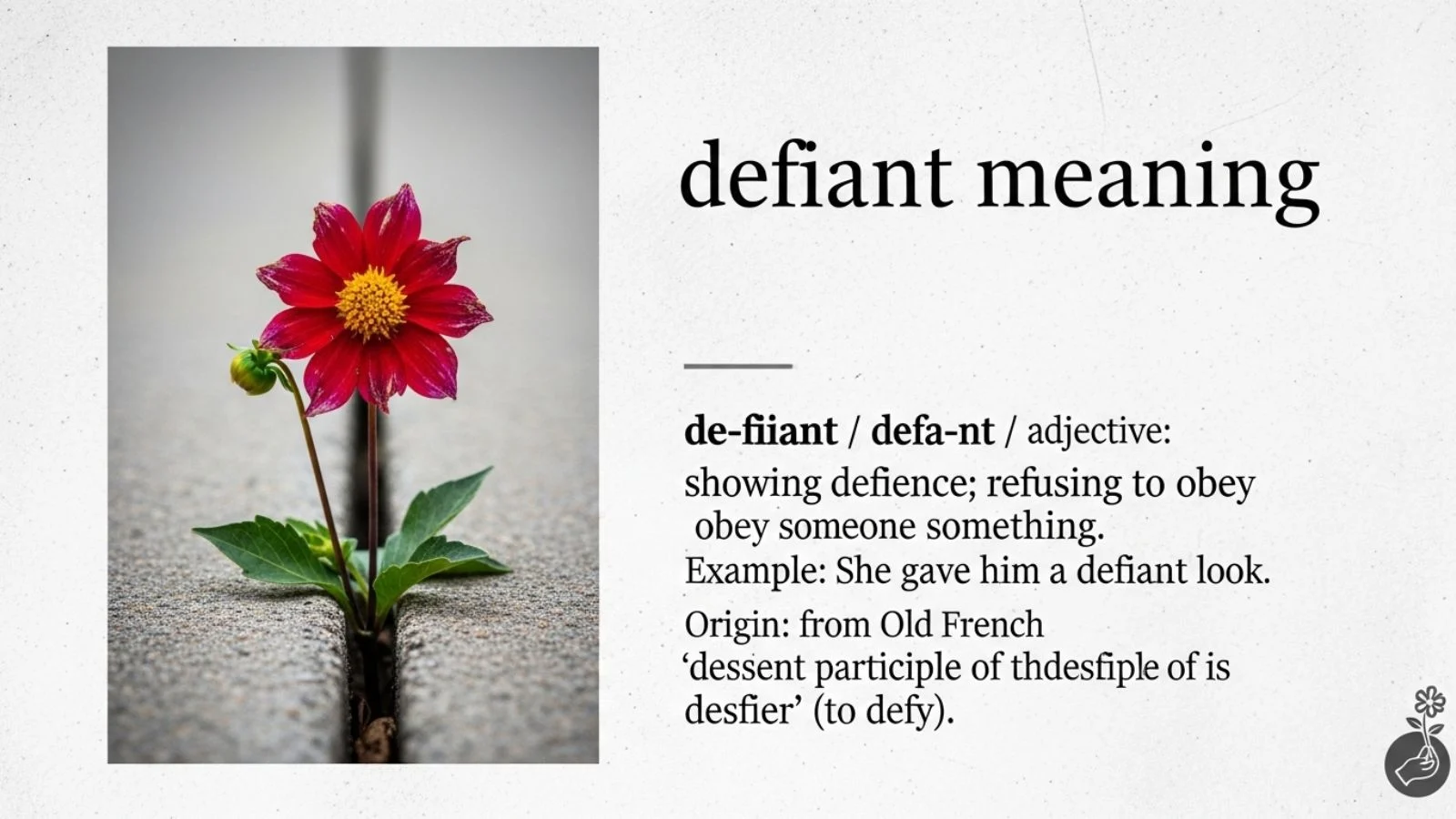
The word defiant is common in English.
You may hear it in school, at work, in movies, or on social media.
But what does defiant really mean?
In this complete guide, you will learn:
- The clear meaning of defiant
- Its origin and history
- Real-life examples with short dialogues
- Personality traits of a defiant person
- Modern 2026 usage
- Common mistakes
- FAQs people often ask
This guide uses simple English so everyone can understand.
Clear Meaning of Defiant (Simple Definition)
Defiant means showing bold resistance.
It describes someone who does not obey rules or authority and openly shows it.
Simple Definition:
Defiant = refusing to obey + showing it clearly
A defiant person does not quietly disagree.
They show their disagreement openly.
Very Simple Meaning for Beginners
- If someone says, “Sit down,”
- And you stand up and say, “No,”
- That behavior is defiant.
It is not silent.
It is strong and visible.
What Does Defiant Feel Like?
Being defiant often includes:
- Anger
- Confidence
- Strong belief
- Refusal to follow rules
Sometimes it is negative.
Sometimes it is brave.
It depends on the situation.
Origin and History of the Word Defiant
The word defiant comes from the Latin word:
- “defiare”
Meaning: to challenge or reject
Later it came into Old French as:
- “defiant” – challenging
By the 14th century, English speakers began using defiant to describe someone who openly resists power.
So from history, the word always meant:
To challenge authority boldly
Pronunciation of Defiant
Defiant is pronounced as:
di-FY-uhnt
Break it into parts:
- di
- fy
- uhnt
Stress is on FY.
Defiant in a Sentence (Basic Examples)
Here are simple examples:
- The child gave a defiant look.
(The child showed refusal in their eyes.) - She crossed her arms in a defiant way.
(She showed she would not agree.) - He spoke in a defiant voice.
(His voice showed resistance.) - The team remained defiant after losing.
(They refused to give up.)
Each example shows open resistance.
Real-Life Examples with Short Dialogues
Example 1: Parent and Teen
Mother: “You cannot go out tonight.”
Teen: “I’m going anyway.”
This response is defiant because the teen openly refuses.
Example 2: School Situation
Teacher: “Stop talking.”
Student: “Why should I?”
The student shows defiance by questioning authority.
Example 3: Workplace Situation
Boss: “Finish this today.”
Employee: “That’s not fair. I won’t.”
This shows defiant behavior because the employee openly rejects the order.
Example 4: Positive Defiance
Friend 1: “Everyone is copying in the exam.”
Friend 2: “I won’t cheat.”
This is positive defiance.
The student resists peer pressure.
Is Defiant Always Negative?
No.
Defiant can be:
- Negative (bad behavior)
- Positive (standing up for justice)
Negative Defiance
- Breaking school rules
- Disrespecting elders
- Ignoring laws
This causes problems.
Positive Defiance
- Standing against bullying
- Fighting for equal rights
- Refusing corruption
This can be brave and powerful.
So context matters.
Personality Traits of a Defiant Person
A defiant person often has strong traits.
Common Traits
- Strong-willed
- Independent
- Bold
- Stubborn
- Confident
- Emotionally intense
Table: Positive vs Negative Traits
| Positive Side | Negative Side |
|---|---|
| Brave | Stubborn |
| Independent | Disrespectful |
| Strong belief | Angry |
| Courageous | Rebellious |
Defiance can build leaders.
But it can also create conflict.
Defiant vs Similar Words
Many words are close to defiant.
But they are not exactly the same.
1. Defiant vs Rebellious
- Defiant = openly refusing authority
- Rebellious = wanting to break rules often
A rebellious person may always resist.
A defiant person resists in a specific moment.
2. Defiant vs Disobedient
- Disobedient = not following rules
- Defiant = not following rules AND showing resistance clearly
Defiance includes attitude.
3. Defiant vs Brave
- Brave = not afraid
- Defiant = resisting authority
They can overlap but are different.
Body Language of a Defiant Person
You can often see defiance without words.
Common Signs:
- Crossed arms
- Direct eye contact
- Raised chin
- Firm voice
- Tight jaw
Example:
“She stood with crossed arms and a defiant stare.”
Her body showed resistance.
Psychological Meaning of Defiant
In psychology, defiant behavior is often linked to:
- Authority conflict
- Identity development (especially in teens)
- Emotional control issues
Teenagers often show defiance because they want independence.
That does not always mean they are bad.
It means they are growing.
Defiant Behavior in Children
Children may act defiant when:
- They feel unheard
- They want control
- They feel treated unfairly
Example:
Parent: “Eat your vegetables.”
Child: “No! I won’t!”
This is defiance.
Parents must guide, not punish harshly.
Defiant in Literature and Movies
Many heroes are defiant.
Examples:
- A character who fights injustice
- A leader who challenges a dictator
- A student who stands against bullying
Defiant characters are often strong and memorable.
Modern Usage of Defiant in 2026
In 2026, the word is common in:
- Social media captions
- News headlines
- Political debates
- Youth culture
Social Media Example
“She posted a defiant message after being criticized online.”
Meaning: She refused to feel ashamed.
News Example
“The activist gave a defiant speech.”
Meaning: The activist openly challenged authority.
Gen Z and Defiance
Young people in 2026 often show defiance when:
- Challenging social norms
- Fighting climate change
- Supporting equality movements
Defiance today often connects to social justice.
How to Use Defiant Correctly
Use defiant when:
- Someone resists authority openly
- Someone shows bold refusal
- Someone challenges power directly
Sentence Structure
Subject + is/was + defiant
Example:
He was defiant during the meeting.
Common Mistakes and Misconceptions
Mistake 1: Thinking Defiant Means Angry Only
Defiant does not always mean angry.
It means resistant.
Mistake 2: Confusing Defiant with Defensive
- Defiant = challenging
- Defensive = protecting yourself
They are different.
Mistake 3: Using It for Quiet Disagreement
If someone disagrees silently, that is not defiant.
Defiance must be visible.
Synonyms of Defiant
Here are common synonyms:
- Bold
- Rebellious
- Resistant
- Challenging
- Stubborn
- Fearless
Each has a slightly different meaning.
Antonyms of Defiant
Opposite words include:
- Obedient
- Respectful
- Submissive
- Cooperative
- Compliant
These show agreement instead of resistance.
Emotional Impact of Defiance
Defiance can:
- Create tension
- Inspire others
- Cause conflict
- Show courage
It depends on the goal.
When Is Defiance Healthy?
Healthy defiance happens when:
- You stand against injustice
- You protect your values
- You resist peer pressure
- You defend your rights
Unhealthy defiance happens when:
- You reject advice blindly
- You break rules for no reason
- You hurt others
Balance is important.
Workplace Defiance
In professional life, defiance can be risky.
Example:
Employee: “I disagree with this policy.”
If said respectfully, it is assertive.
If said angrily and publicly, it becomes defiant.
Professional tone matters.
Cultural Differences in Defiance
In some cultures:
- Defiance is seen as disrespect.
In others:
- Defiance is seen as independence.
Understanding culture helps avoid misunderstanding.
Defiant Tone in Writing
Writers use defiant tone to show strength.
Example:
“I will not give up.”
This sentence shows defiance.
It communicates courage and resistance.
Mini Practice Section
Choose if the sentence shows defiance:
- She quietly disagreed.
Not defiant. - He shouted, “I refuse!”
Defiant. - She followed the rules.
Not defiant. - He stood firm and said no.
Defiant.
Practice helps learning.
FAQs About Defiant Meaning
1. What does defiant mean in simple words?
It means refusing to obey and showing it clearly.
2. Is defiant a bad word?
Not always.
It can be negative or brave depending on context.
3. What is an example of defiant behavior?
A student saying, “I won’t do it,” to a teacher in an angry tone.
4. What is the difference between defiant and rebellious?
Defiant is a moment of resistance.
Rebellious is a personality pattern.
5. Can defiance be positive?
Yes.
Standing against injustice is positive defiance.
6. Why are teenagers often defiant?
They want independence and control over their identity.
7. How do you deal with a defiant person?
Stay calm.
Listen to their reason.
Respond respectfully.
Quick Summary Table
| Word | Meaning |
|---|---|
| Defiant | Open resistance |
| Defiance | Noun form |
| Defy | Verb form |
| Defiant attitude | Bold refusal |
Final Thoughts on Defiant Meaning
The word defiant describes someone who openly resists authority. It shows bold refusal and strong emotion. Defiance can be negative, like breaking rules without reason. It can also be positive, like standing against injustice. The meaning depends on context, tone, and purpose. Understanding this word helps improve communication, reading skills, and emotional awareness. Now that you know the full meaning, examples, traits, and correct usage, try using the word in your own sentences. Keep learning new words daily to grow your English confidence and clarity.
Discover More Post
ETOH Meaning: Simple Definition, Medical Use, Origin, and Real-Life Examples (2026)
Crodie Meaning: Simple Definition, Origin, Slang Usage & Real Examples (2026 Guide)
AFAIK Meaning: Full Form, Simple Definition, Examples & How to Use It (2026 Guide)