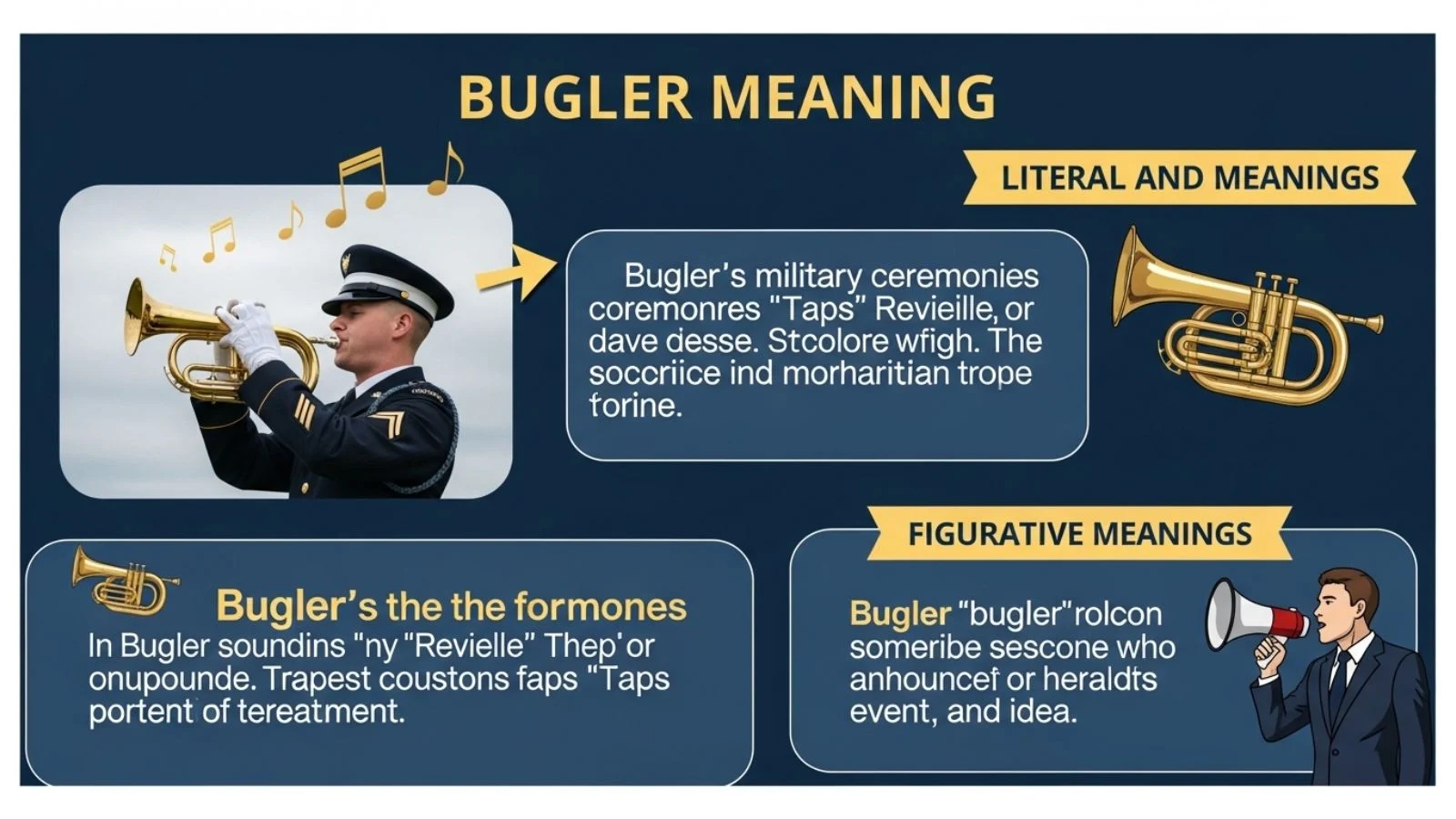
The word bugler may sound old or serious. You may hear it in movies, army stories, or history books. But what does it really mean?
In this easy guide, you will learn:
- The clear meaning of bugler
- Where the word comes from
- Real-life examples
- Short dialogues
- Personality traits of a bugler
- Common mistakes
- Modern uses in 2026
- FAQs people ask online
This article uses simple English so everyone can understand.
What Does Bugler Mean?
A bugler is a person who plays a musical instrument called a bugle.
A bugle is a small brass instrument. It looks like a short trumpet. It has no keys or valves.
So, in simple words:
A bugler is someone who blows a bugle to make clear and loud signals.
Buglers are often seen in:
- The army
- Military ceremonies
- Parades
- Funerals
- Historical events
Simple Definition of Bugler
Here is the easy meaning:
Bugler (noun): A person who plays the bugle, usually to give signals in the military.
Let’s break it down:
- Bugle = a brass instrument
- -er = a person who does something
So:
- Teach → teacher
- Drive → driver
- Bugle → bugler
Very simple.
What Is a Bugle?
Before fully understanding bugler, we must know what a bugle is.
A bugle is:
- A brass musical instrument
- Small and curved
- Without buttons or keys
- Very loud
It is used for:
- Waking soldiers
- Signaling attack or retreat
- Ceremonies
- Honoring the dead
The bugle makes clear and sharp sounds that can travel far.
Origin and History of the Word Bugler
Understanding the history helps us understand the word better.
Word Origin
The word bugle comes from Latin and French roots.
- Latin word “buculus” means young bull.
- Old French word “bugle” means wild ox.
Long ago, horns were made from animal horns, especially ox horns. People used them to send signals.
Later, metal bugles replaced animal horns.
The word bugler appeared in English in the 17th century.
History of Buglers in the Military
Buglers played a very important role in history.
Before Modern Technology
In old times:
- There were no radios.
- There were no loudspeakers.
- Soldiers could not use mobile phones.
So how did they communicate on the battlefield?
They used:
- Drums
- Flags
- Bugles
A bugler would stand at a high place and play different tunes.
Each tune had a special meaning.
For example:
- One tune meant “Wake up.”
- Another meant “Attack.”
- Another meant “Retreat.”
The sound of the bugle could travel across fields and hills.
Famous Military Bugle Calls
Here are some common bugle calls:
| Bugle Call | Meaning | When It Is Used |
|---|---|---|
| Reveille | Wake up | Early morning |
| Taps | Honor the dead | Military funerals |
| Charge | Attack | During battle |
| Retreat | End of day | Evening |
Each call has a special melody.
A trained bugler must remember and play them correctly.
Real-Life Examples of Bugler
Let us look at simple examples.
Example 1
The bugler played Reveille at sunrise.
Explanation: The bugler woke up soldiers by playing a morning tune.
Example 2
A young soldier trained to become a bugler.
Explanation: The soldier learned how to play the bugle for army signals.
Example 3
The bugler played Taps at the funeral.
Explanation: The bugler honored a dead soldier with a special tune.
Example 4
During the parade, the bugler marched proudly.
Explanation: The bugler walked with the band and played music.
Short Dialogues Using Bugler
These short conversations help beginners understand better.
Dialogue 1: In the Army Camp
Officer: Who will wake the soldiers tomorrow?
Soldier: The bugler will play at 5 a.m.
Explanation: The bugler has the duty to wake everyone with music.
Dialogue 2: At a Ceremony
Child: Why is that man playing a small trumpet?
Father: He is a bugler. He plays to honor the soldiers.
Explanation: The bugler plays music at serious events.
Dialogue 3: At School
Teacher: What does a bugler do?
Student: A bugler plays the bugle to give signals.
Explanation: The student correctly explains the job.
Personality Traits of a Bugler
A bugler needs special qualities.
Here are common traits:
- Disciplined – Follows strict timing
- Brave – May play in dangerous places
- Focused – Must not play wrong signals
- Loud and confident – Sound must be clear
- Responsible – Lives may depend on signals
In history, playing the wrong tune could cause confusion in battle.
So the role was very serious.
Where Is the Word Bugler Used Today?
In 2026, the word bugler is not common in daily talk.
But it is still used in:
- Military schools
- History books
- War movies
- Parades
- Ceremonies
- Remembrance events
It may also appear in novels or poems.
Modern and Relatable Examples (Updated 2026)
Even though technology is advanced, buglers are still present.
1. Military Funerals
At official funerals, a real bugler plays Taps live.
Some events use recorded music, but many still prefer a live bugler.
2. National Celebrations
During national holidays, buglers play in parades.
Example: Independence Day ceremonies.
3. Historical Reenactments
In 2026, many countries hold historical shows.
Actors dress like old soldiers.
A bugler plays old military tunes.
4. Movies and TV Shows
War films often show a bugler before battle scenes.
This creates a serious and emotional mood.
5. Scouts and Cadet Programs
Some youth programs still teach bugle playing.
It helps students learn discipline and teamwork.
Difference Between Bugler and Trumpeter
Many people confuse these two words.
Let us compare.
| Feature | Bugler | Trumpeter |
|---|---|---|
| Instrument | Bugle | Trumpet |
| Valves | No | Yes |
| Usage | Military signals | Music bands |
| Sound Control | Limited notes | Many notes |
A bugler plays simple tunes.
A trumpeter can play complex music.
Common Mistakes and Misconceptions
Here are mistakes people often make.
Mistake 1: Thinking a Bugler Is a Singer
Wrong. A bugler does not sing.
A bugler plays a bugle.
Mistake 2: Thinking Bugle and Trumpet Are the Same
They look similar but are different.
A trumpet has buttons.
A bugle does not.
Mistake 3: Using Bugler for Any Musician
Not correct.
Only someone who plays the bugle is a bugler.
Mistake 4: Thinking Buglers Are Only in Old Times
Not true.
Buglers still perform in 2026 ceremonies.
Grammar and Usage Tips
The word bugler is:
- A countable noun
- Used for a person
Examples:
- One bugler
- Two buglers
Sentence examples:
- The bugler stood at attention.
- The buglers practiced daily.
Is Bugler a Positive or Negative Word?
The word is mostly positive or neutral.
It shows:
- Honor
- Respect
- Discipline
- Service
It is often linked to bravery and tradition.
Synonyms of Bugler
There are not many exact synonyms.
But similar terms include:
- Military musician
- Horn player (general term)
- Signal player
These are not exact matches, but related ideas.
Related Words
Here are words connected to bugler:
- Bugle
- Military band
- Ceremony
- Reveille
- Taps
- Parade
- Signal
Understanding these words helps you understand bugler better.
Why Is the Role of a Bugler Important?
In history, buglers:
- Saved lives
- Organized troops
- Gave clear commands
In ceremonies, buglers:
- Show respect
- Create emotional moments
- Keep tradition alive
Even today, when a bugler plays Taps, many people feel deep respect.
How to Use Bugler in Writing
You can use bugler in:
- History essays
- Stories
- Military reports
- News articles
Example in a story:
The bugler stood alone on the hill and played the final call.
Explanation: This shows a serious or emotional moment.
Bugler in Literature and Culture
In many war novels, the bugler is shown as:
- Young but brave
- Loyal to the army
- Calm under pressure
Writers use the image of a bugler to create strong emotions.
The sound of a bugle often means:
- Start of action
- End of life
- Honor and memory
Fun Facts About Buglers
Here are some interesting facts:
- Bugles were once made from real animal horns.
- Some armies train special ceremonial buglers.
- The tune Taps has only 24 notes.
- A bugle cannot play all musical scales.
These facts make the word more interesting.
Quick Summary Table
| Question | Answer |
|---|---|
| What is a bugler? | A person who plays the bugle |
| Where are buglers seen? | Military, parades, funerals |
| Is it modern? | Yes, still used in ceremonies |
| Is it positive? | Yes, usually respectful |
| Is it same as trumpeter? | No |
Frequently Asked Questions
1. What does bugler mean in simple words?
A bugler is a person who plays a bugle, usually in the military to give signals or honor soldiers.
2. Is a bugler only found in the army?
Mostly yes, but buglers also play at parades, ceremonies, and historical events.
3. What instrument does a bugler play?
A bugler plays a bugle, which is a small brass instrument without buttons.
4. Is bugler still used in 2026?
Yes. Buglers still perform at military funerals, national events, and ceremonial programs.
5. What is the difference between a bugler and a trumpeter?
A bugler plays a bugle without valves.
A trumpeter plays a trumpet with valves and can play more complex music.
6. Can anyone become a bugler?
Yes, but the person must learn bugle calls and practice regularly. Discipline is important.
7. Why is the bugler important in history?
Before modern technology, buglers gave important signals in battle. Soldiers depended on them.
Conclusion
The word bugler may seem simple, but it carries deep meaning. A bugler is more than just a musician. This person plays an important role in history, tradition, and honor. From old battlefields to modern ceremonies in 2026, buglers continue to serve with discipline and pride. They remind us of courage, respect, and memory. Understanding words like bugler helps improve vocabulary and cultural knowledge. If you enjoy learning clear and simple word meanings, keep exploring and growing your English skills every day.
Discover More Post
Ohana Meaning: Simple Definition, Origin, Examples & Modern Use (2026)
Ad Vitam Meaning: Simple Definition, Origin, Examples, and Modern Usage (2026)
Down Bad Meaning: Simple Definition, Origin, Examples, and Modern Use (2026 Guide)