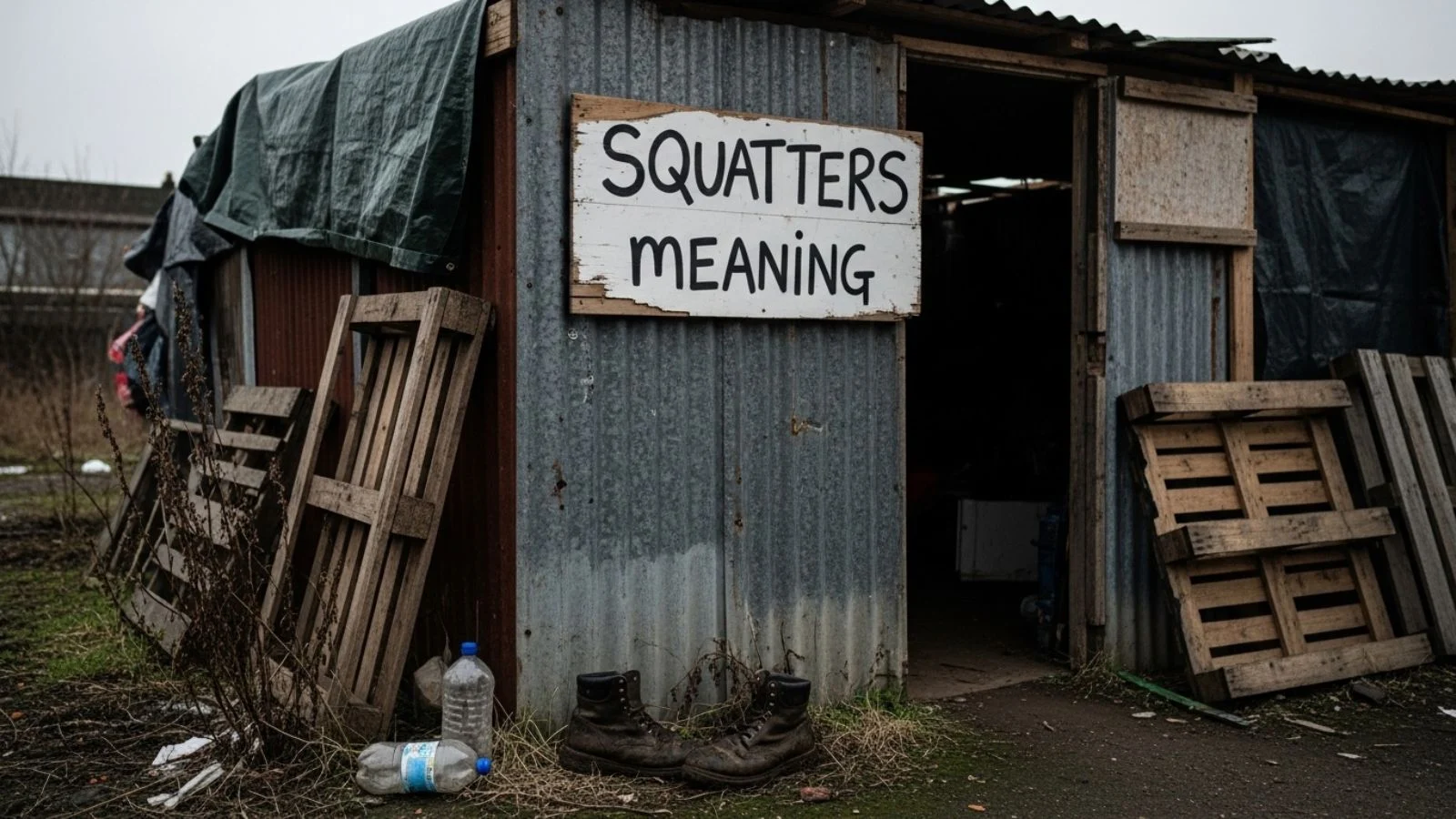
The word squatters is often used in news, movies, and social media. But many people do not fully understand what it means.
Is a squatter a criminal?
Is it always illegal?
Do squatters have rights?
In this complete guide, you will learn the clear meaning of squatters, their history, legal context, real-life examples, personality traits, common myths, and modern updates for 2026.
This article uses simple English. Each example is explained clearly so beginners can understand easily.
What Does Squatters Mean? (Simple Definition)
Squatters are people who live in a property without the owner’s permission.
They move into a house, building, or land that belongs to someone else. They do not rent it. They do not own it. They simply stay there.
In very simple words:
A squatter is someone who uses or lives in a place without legal permission.
Squatters Meaning in One Sentence
A squatter is a person who occupies an empty property without the owner’s approval.
Key Features of Squatting
Here are some important points:
- The property is usually empty or abandoned
- The squatter does not have legal ownership
- They may stay for days, months, or even years
- Laws about squatters are different in each country
Origin and History of the Word “Squatter”
The word squat originally meant “to sit down” or “to crouch.”
Early Use (17th–18th Century)
In the 1700s, settlers moved to land that did not officially belong to them. They settled there without legal documents.
These people were called squatters.
19th Century Expansion
In countries like the United States and Australia, people moved to unused land and started farming. Many did not have official ownership at first.
Later, some governments created laws that allowed them to legally own the land after living there for a long time.
This idea later became known as adverse possession (explained below).
Squatters vs Trespassers: What’s the Difference?
Many people confuse squatters with trespassers.
Here is a simple comparison table:
| Feature | Squatter | Trespasser |
|---|---|---|
| Permission | No | No |
| Intent | Often stays long-term | Usually short-term |
| Property Condition | Often empty | Can be any property |
| Legal Rights | May gain rights over time | Usually no rights |
Simple Explanation
A trespasser enters property without permission, often briefly.
A squatter stays longer and may try to claim rights.
What Is Adverse Possession?
Adverse possession is a legal rule in some countries.
It allows a squatter to become the legal owner of a property after living there openly for many years.
Basic Conditions (varies by country):
- The property must be occupied openly
- The occupation must be continuous
- The owner must not object for many years
- The squatter must treat it like their own property
In simple words:
If someone lives in a property for a very long time and the owner does nothing, the law may give ownership to the squatter.
This does not happen quickly. It usually takes many years.
Why Do People Become Squatters?
Not all squatters are criminals. Some become squatters because of difficult life situations.
Common Reasons:
- Homelessness
- Poverty
- Lack of affordable housing
- Political protest
- Abandoned properties left unused
Example 1
Ali loses his job and cannot pay rent. He finds an empty house and moves in.
Explanation: Ali becomes a squatter because he lives in a house without permission.
Real-Life Examples with Short Dialogues
Example 2: Abandoned House
Sara notices an old house has been empty for 5 years. She moves in.
Owner: “Why are you in my house?”
Sara: “No one lived here. It was empty.”
Explanation: Even if the house was empty, Sara still needs permission.
Example 3: Long-Term Occupation
Tom lives in a vacant building for 15 years. The owner never checks it.
Tom: “I have lived here for 15 years.”
Lawyer: “You may qualify under adverse possession.”
Explanation: In some places, long-term occupation may create legal rights.
Example 4: Social Media Case (2026 Update)
A family shares on social media that someone moved into their vacation home while they were abroad.
Neighbor: “I saw strangers entering last week.”
Owner: “I did not give permission!”
Explanation: Squatting cases often become viral online in 2026.
Are Squatters Always Criminals?
Not always.
Some squatters break the law. Others may fall into legal grey areas.
Important Point
- Breaking into a home is illegal.
- But staying in an empty property may sometimes involve civil law, not criminal law.
Laws vary by country and state.
Legal Rights of Squatters (General Overview)
Laws are different everywhere. But generally:
- Squatters may have limited rights after long occupation
- Police may need a court order to remove them
- Property owners must follow legal eviction steps
Personality Traits Often Linked to Squatters
Not every squatter has the same personality. But certain patterns are common.
1. Risk-Taking
They take big risks by living without permission.
2. Resourceful
They often fix broken spaces and survive with few resources.
3. Desperate
Some act out of need, not choice.
4. Activist-Minded
Some squatters protest housing systems.
Modern Squatting in 2026
Squatting looks different today compared to 100 years ago.
1. Urban Housing Crisis
In many cities:
- Rent prices are very high
- Housing supply is low
- Homelessness has increased
This leads to more squatting cases.
2. Social Media Awareness
In 2026:
- Homeowners post videos of squatters
- Squatters share their side of the story
- Legal advice spreads online
This makes squatting more visible.
3. Empty Investment Properties
Some buildings are owned by investors but stay empty for years.
Some squatters argue:
“If it’s empty, why can’t people live there?”
This creates public debate.
Common Misconceptions About Squatters
Myth 1: All Squatters Are Criminals
Truth: Some are homeless or struggling families.
Myth 2: Squatters Instantly Own Property
Truth: It usually takes many years under strict rules.
Myth 3: Police Can Always Remove Them Immediately
Truth: In some places, owners must go through court.
Myth 4: Squatting Is Always Illegal
Truth: It depends on local law and circumstances.
Squatters in News and Media
News often uses strong headlines:
- “Family Finds Squatters in Vacation Home”
- “City Battles Rising Squatting Cases”
Media coverage increases fear, but each case is different.
Emotional and Social Impact
On Property Owners
- Stress
- Financial loss
- Legal costs
- Fear of damage
On Squatters
- Uncertainty
- Legal risk
- Social judgment
- Lack of security
How Property Owners Can Protect Themselves
Prevention Tips
- Regularly check property
- Install security systems
- Keep utilities active
- Post clear “No Trespassing” signs
- Maintain insurance
Simple explanation: Regular visits show the property is not abandoned.
Legal Steps to Remove Squatters
This depends on location, but usually includes:
- Serve eviction notice
- File court case
- Get court order
- Law enforcement removes occupants
Owners should never use force. That can create legal trouble.
Squatting vs Homelessness
Not all homeless people are squatters.
Not all squatters are homeless.
Some squatters choose abandoned buildings as protest.
Some homeless people stay in shelters instead.
Squatters in Different Countries (General View)
United States
Adverse possession laws exist but require strict conditions.
United Kingdom
Squatting in residential buildings became illegal in 2012, but some civil property rules still apply.
Australia
Historical squatting shaped early land settlement.
Ethical Debate Around Squatting
There are two main sides:
Property Rights Argument
Owners worked hard for property. It should be protected.
Housing Rights Argument
Empty buildings should not exist while people are homeless.
Both sides raise important social questions.
Language Usage: How to Use “Squatter” in a Sentence
Correct usage examples:
- “The police removed the squatters from the abandoned building.”
- “The owner filed a case against the squatter.”
Wrong usage:
- “He is squatting meaning.”
This is grammatically incorrect.
Related Words and Terms
- Adverse possession
- Eviction
- Trespassing
- Property rights
- Land dispute
Common Mistakes When Understanding Squatters
- Thinking it happens overnight
- Assuming all squatters win legal rights
- Believing police can ignore legal process
- Confusing renters with squatters
A renter has permission. A squatter does not.
Psychological and Social Factors
Some squatters feel:
- Society failed them
- Housing is unfair
- Empty homes are wasted
Others simply seek survival.
Understanding motives helps reduce extreme judgment.
Squatters Meaning for Students
If you are a student:
Remember this simple sentence:
A squatter lives in a place without the owner’s permission.
That is the basic meaning.
Frequently Asked Questions
1. Is squatting illegal?
It depends on the country and type of property. Breaking in is usually illegal.
2. Can squatters really own a house?
In rare cases, yes. But only after many years under strict legal rules.
3. How long does adverse possession take?
It can take 5–20 years or more, depending on the law.
4. Can police remove squatters immediately?
Sometimes yes. Sometimes a court order is required first.
5. Why do squatters target empty houses?
Empty houses appear abandoned and easier to occupy.
6. Are squatters and tenants the same?
No. Tenants have permission and a rental agreement. Squatters do not.
Final Summary Table
| Topic | Simple Meaning |
|---|---|
| Squatter | Person living without permission |
| Trespasser | Person entering without permission |
| Adverse Possession | Law that may grant ownership after long stay |
| Eviction | Legal removal process |
Conclusion
The squatters meaning is simple: a person who lives in a property without the owner’s permission. But the topic itself is complex. It connects to history, law, poverty, housing crisis, and property rights. Not all squatters are criminals, and not all property owners are careless. Laws differ by country, and each case is unique. Understanding the real meaning helps you avoid myths and confusion. If you found this guide helpful, explore more legal and language topics to strengthen your knowledge and stay informed in 2026 and beyond.
Discover More Post
Disingenuous Meaning: Simple Definition, Examples, and Real-Life Usage (2026 Guide)
Yandere Meaning: Simple Definition, Origin, Traits & Real Examples (2026 Guide)
Puto Meaning: Clear Definition, Origin, Usage & Modern Context (2026 Guide)