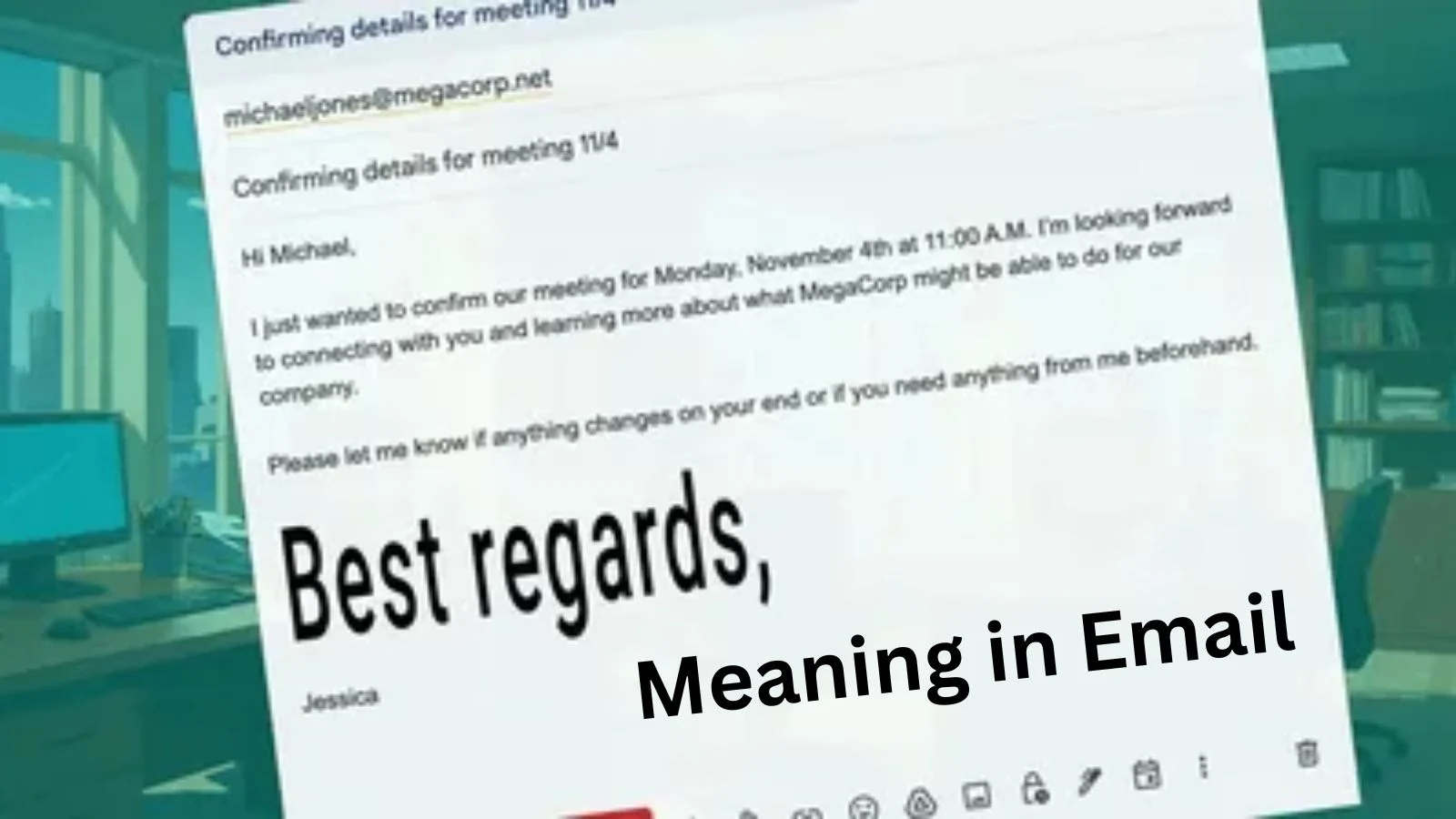
Emails are part of daily life.
We send emails for work, school, business, and personal messages.
At the end of many emails, you see one word:
Regards
But what does regards meaning in email really mean?
Is it polite?
Is it formal or casual?
When should you use it?
This complete guide explains everything in very simple words, with real examples and easy rules.
Even beginners will understand.
What Does “Regards” Mean in an Email?
Regards is a polite closing word used at the end of an email.
Simple Meaning
Regards means:
Good wishes
Polite respect
Friendly but professional ending
It shows you are ending the email nicely.
One-Line Definition
Regards is a polite way to say “I respect you and wish you well” at the end of an email.
Why Do People Use “Regards” in Emails?
People use regards because it is:
- Polite
- Professional
- Safe for most situations
- Easy to understand
- Accepted worldwide
It works well in:
- Work emails
- Business emails
- School emails
- Customer support emails
Origin and History of the Word “Regards”
The word “regards” comes from Old French and later Middle English.
At first, it meant to look at or to care about someone.
Over time, it began to show respect and polite feelings toward others.
That is why today “regards” is used to end emails in a kind and professional way.
Where Does “Regards” Come From?
The word regard comes from Old French and Middle English.
Originally, it meant:
- To look at
- To care about
- To show attention
Over time, regards became a way to show:
- Respect
- Care
- Politeness
How It Entered Email Language
Before email, people used regards in:
- Letters
- Formal notes
- Business writing
When emails became popular, regards stayed because it was already trusted and polite.
Is “Regards” Formal or Informal?
Regards is neutral.
That means it is not too formal and not too casual.
Level of Formality
| Closing | Formality Level |
| Regards | Medium |
| Kind regards | Medium-formal |
| Best regards | Medium-formal |
| Sincerely | Very formal |
| Thanks | Casual |
| Cheers | Informal |
When Should You Use “Regards” in an Email?
You can use regards when:
- Writing to a colleague
- Emailing a client
- Contacting a teacher
- Replying to customer support
- Sending a professional message
Good Situations to Use “Regards”
- First email to someone new
- Ongoing work conversations
- Professional but friendly tone
- Neutral communication
When NOT to Use “Regards”
Do not use regards when:
- Emailing close friends
- Sending very casual messages
- Writing emotional emails
- Sending angry or complaint emails
How to Use “Regards” Correctly in an Email
Correct Format
Always place regards at the end of the email, before your name.
Correct example:
Regards,
Hafiza
Capitalization Rules
- Regards → Capital “R” (recommended)
- regards → also correct, but less common
Real-Life Email Examples (With Explanation)
Example 1: Work Email
Thank you for your time.
Regards,
Hafiza
Explanation:
This sounds polite and professional. Good for office use.
Example 2: Client Email
Please let me know if you need more details.
Regards,
Hafiza
Explanation:
Shows respect and keeps a professional tone.
Example 3: Teacher Email
I look forward to your response.
Regards,
Hafiza
Explanation:
Formal enough for school or college emails.
Short Dialogue Examples (Easy to Understand)
Dialogue 1
Ali: How should I end my email to my boss?
Sara: Use “Regards.” It is polite and safe.
Explanation:
Regards works well with seniors.
Dialogue 2
User: Is “Regards” rude?
Expert: No. It is neutral and respectful.
Explanation:
Regards is not rude when used correctly.
Different Types of “Regards” and Their Meanings
1. Regards
- Neutral
- Professional
- Safe choice
2. Kind Regards
- Politer
- Warmer
- Slightly formal
3. Best Regards
- Friendly
- Professional
- Very common in business
4. Warm Regards
- Friendly
- Personal
- Less formal
Comparison Table
| Phrase | Tone | Best For |
| Regards | Neutral | Work emails |
| Kind regards | Polite | Clients, teachers |
| Best regards | Friendly | Professional chats |
| Warm regards | Personal | Known contacts |
Personality Traits Shown by Using “Regards”
When you use regards, people may think you are:
- Polite
- Respectful
- Professional
- Calm
- Well-educated
It gives a mature and balanced impression.
Common Mistakes People Make with “Regards”
Mistake 1: Using It in Angry Emails
Wrong
I am very unhappy.
Regards
Better
Use a neutral ending or fix the tone first.
Mistake 2: Forgetting the Name
Wrong
Regards
Correct
Regards,
Hafiza
Mistake 3: Using It with Emojis
Wrong
Regards
Correct
Regards,
Mistake 4: Using It in Very Casual Chats
Wrong
See you later!
Regards
Better
Use “Thanks” or “Bye”.
Modern Usage of “Regards” (Updated for 2026)
In 2026, email writing is:
- Short
- Clear
- Polite
Regards is still popular because:
- AI emails use neutral language
- Remote work needs professionalism
- Global communication prefers safe words
Even modern companies still accept regards as a professional ending.
Regards vs Thanks (Quick Comparison)
| Regards | Thanks |
| Polite closing | Shows gratitude |
| Neutral tone | Friendly tone |
| Professional | Semi-casual |
| Safe for all | Not for all emails |
Should You Use “Regards” in Job Emails?
Yes.
It is one of the best choices for:
- Job applications
- Interview follow-ups
- HR emails
Example:
Thank you for considering my application.
Regards,
Hafiza
Frequently Asked Questions
Is “Regards” polite in emails?
Yes. Regards is polite and professional.
Is “Regards” formal or informal?
It is neutral. Not too formal, not too casual.
Can I use “Regards” with my boss?
Yes. It is safe and respectful.
Is “Kind regards” better than “Regards”?
Kind regards sounds a bit warmer, but both are correct.
Can I use “Regards” in personal emails?
You can, but it may sound too formal for close friends.
Is it rude to end an email with “Regards”?
No. It is not rude if the email tone is polite.
Should I use a comma after “Regards”?
Yes.
Always write:
Regards,
Conclusion
Regards is a simple, polite, and professional way to end an email.
It shows respect, balance, and good manners.
That is why it is still popular in 2026. If you want a safe email ending that works in almost every situation, regards is a smart choice.
Discover More Post
Femdom Meaning in English (Simple, Clear & Complete Guide)
MMCHT Meaning in Text (2026 Guide): What It Means, Examples & How to Use It
Vosotros Meaning in English – Simple Definition, Examples & Usage (2026 Guide)