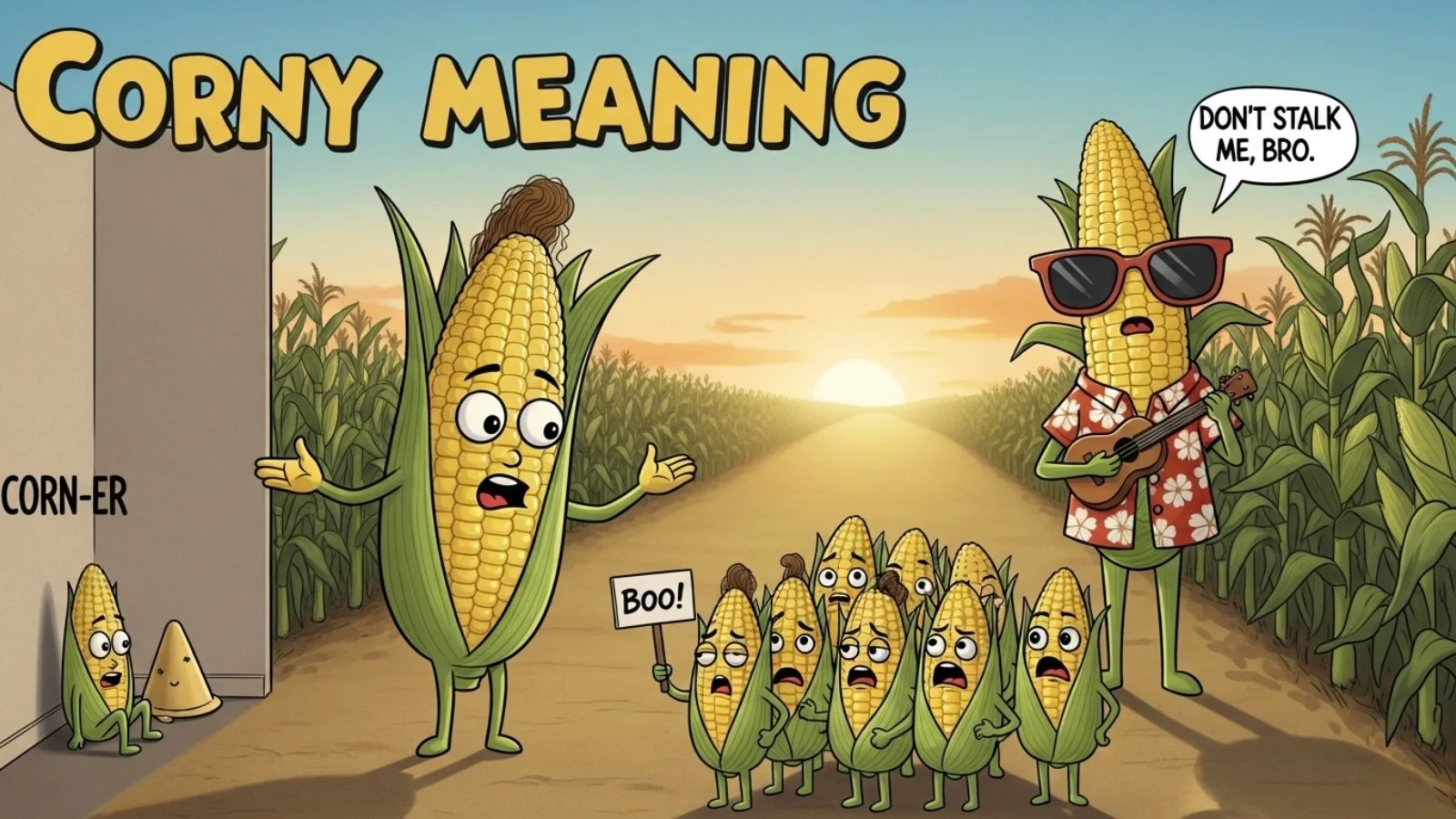
The word corny is used to describe something that is overly sentimental, old-fashioned, or cheesy. When something is corny, it often feels exaggerated, silly, or lacking originality.
- Example: “That movie was so corny, but I still enjoyed it.”
Explanation: The speaker thinks the movie is predictable or cheesy, but not entirely bad. - Example: “He gave me a corny compliment about my smile.”
Explanation: The compliment feels overly sweet or cliché rather than natural.
In simple words, if something makes you roll your eyes because it feels too fake or outdated, it is likely corny.
Origin and History of the Word Corny
The term corny comes from the early 20th century American English, originally meaning “simple, unrefined, or rustic.”
- 1920s: The word began to describe jokes, stories, or phrases that were old-fashioned or overly sentimental.
- 1930s: It became common in popular culture to describe movies, songs, or speeches that were overly predictable.
- The word corny is linked to “corn,” a crop associated with simple rural life, which gave the idea of something unsophisticated.
So, over time, corny evolved from “simple” to “cheesy or exaggerated”, which is how we use it today.
How Corny Is Used in Real Life
The word corny is widely used in conversations, movies, and social media. It is often used to lightly tease or criticize something without being harsh.
Short Dialogues Examples
Example 1:
- Person A: “I wrote a poem for you.”
- Person B: “That’s sweet, but a little corny.”
Explanation: Person B thinks the poem is overly sentimental but appreciates the effort.
Example 2:
- Person A: “Do you want to see my dance moves?”
- Person B: “Oh no, don’t be corny!”
Explanation: Person B thinks the dance might look silly or outdated.
Example 3:
- Person A: “Let’s watch a romantic comedy.”
- Person B: “Sure, but no corny lines, please.”
Explanation: Person B wants humor and romance that feels modern, not exaggerated.
Personality Traits and Usage Context
People often use corny to describe:
- Romantic gestures – like poems, messages, or gifts that feel too exaggerated.
- Jokes or humor – especially jokes that are predictable or cheesy.
- Movies, songs, or shows – that feel outdated or melodramatic.
- Phrases or compliments – that feel cliché.
Personality traits of someone likely to use “corny”:
- Observant and critical of clichés.
- Prefers modern or original expressions.
- Enjoys humor that is fresh rather than predictable.
Examples of Corny Things in Everyday Life
| Category | Corny Example | Explanation |
|---|---|---|
| Romance | “I love you to the moon and back.” | Predictable, exaggerated expression of love. |
| Movies | Old romantic comedies with predictable endings | Feels cliché and predictable. |
| Jokes | “Why did the chicken cross the road?” | Classic, overused joke. |
| Social Media | Posting overly dramatic captions like “Best day ever, forever and always.” | Feels exaggerated and not genuine. |
| Fashion | Wearing socks with sandals for humor | Cheesy, meant to be funny but outdated. |
Common Mistakes or Misconceptions About Corny
- Corny ≠ Bad – Something corny can still be enjoyable.
- Example: A corny movie can be fun to watch even if predictable.
- Corny ≠ Serious Criticism – Often, it’s playful teasing, not harsh judgment.
- Corny Isn’t Only for Romance – It can describe jokes, movies, fashion, or behavior.
- Corny ≠ Funny for Everyone – What feels corny to one person may be genuinely sweet or funny to another.
- Avoid overusing the term – Calling everything corny can make your speech sound critical or sarcastic.
Modern and Relatable Examples (Updated for 2026)
- AI Chat Messages:
- Example: “Your daily motivation: You are a superstar!”
- Explanation: Overly sweet and predictable message, often called corny.
- TikTok Trends:
- Example: Recreating old romantic scenes with dramatic music.
- Explanation: Feels outdated and exaggerated, making it corny.
- Dating Apps:
- Example: “You complete me.”
- Explanation: Classic cliché used on dating profiles that many users call corny.
- Social Media Captions:
- Example: “Living my best life, forever and always!”
- Explanation: Overused dramatic statement that feels cheesy.
- Memes:
- Example: Predictable memes with outdated humor.
- Explanation: Memes can be intentionally corny for comedic effect.
How to Use Corny Correctly
- Before a noun: “That was a corny joke.”
- After a verb: “He acted corny at the party.”
- In conversation: Use it playfully to describe something exaggerated but not harmful.
Tip: Avoid using it in formal writing unless your tone is casual or humorous.
Corny vs Similar Words
| Word | Meaning | Difference from Corny |
|---|---|---|
| Cheesy | Overly sentimental, cliché | Very similar; “cheesy” often implies humor. |
| Sappy | Excessively emotional | More focused on emotions than style. |
| Cliché | Overused expression or idea | Refers more to phrases or ideas than actions. |
| Lame | Uninteresting or boring | Broader meaning; not necessarily sentimental. |
Real-Life Scenarios with Explanations
Scenario 1: Office Humor
- Colleague A: “I brought donuts to cheer everyone up!”
- Colleague B: “That’s a bit corny, but thanks.”
Explanation: Colleague B finds the gesture sweet but slightly exaggerated.
Scenario 2: Gift Giving
- Friend A: “I made you a scrapbook of our friendship.”
- Friend B: “Wow, this is so corny, I love it!”
Explanation: Friend B thinks it’s cheesy but appreciates the effort.
Scenario 3: Compliments in Dating
- Person A: “You have the most beautiful eyes in the universe.”
- Person B: “That’s corny, but flattering.”
Explanation: Over-the-top compliment is recognized as exaggerated.
Tips for Avoiding Corny Expressions
- Be original: Avoid clichés or overused phrases.
- Be concise: Keep compliments or jokes simple and genuine.
- Observe context: Some corny expressions work in playful or informal settings.
- Add humor carefully: Cheesy jokes can be fun, but overdoing it can be cringy.
FAQs About Corny
1. Is “corny” always negative?
No, it can be playful or affectionate. It describes exaggeration, not necessarily a flaw.
2. Can I call someone corny?
Yes, usually in a teasing or lighthearted way. Avoid using it aggressively.
3. Is “corny” the same as “cheesy”?
Very similar. “Cheesy” often emphasizes humor, while “corny” includes sentimentality and clichés.
4. Where did the word come from?
It originated in early 20th century America, linked to rural life and simple expressions.
5. Can modern social media be corny?
Yes, captions, trends, and memes often use exaggerated phrases that are corny.
6. Is “corny” used in formal writing?
Rarely. It’s mostly informal, casual, and conversational.
7. How do I avoid being corny in speech?
Focus on originality, simplicity, and authenticity in compliments, jokes, and gestures.
Conclusion
The word corny is a versatile term used to describe sentimental, cheesy, or predictable expressions. It can refer to jokes, compliments, movies, or social media trends. While often playful, it’s a useful word to express mild criticism or amusement without offending anyone. Understanding corny helps in both casual conversation and modern cultural references.
Next time you hear something exaggerated or cheesy, you’ll confidently know if it’s corny. Use this knowledge to make your speech engaging, relatable, and current for 2026.
Discover More Post
OOMF Meaning: Simple Definition, Origin, Examples & How to Use It in 2026
Atypical Meaning: Simple Definition, Examples, Origin, and Modern Usage (2026 Guide)
OWI Meaning: Full Definition, Origin, Examples, and Legal Guide (2026)